

I can see quite a bit of the roads around here from back in the pony trailer. I notice when things are different, also outside the Ranch. I was therefore more than a little surprised to see an aluminium ball that pictures a distorted horse at the intersection of County Roads 14 and 31, on the property of Bluebell Ranch.
When we were back home, it became clear that I wasn’t the only one who had been amazed and intrigued by the ball.
“Ya seen that glitter horse ball, Bob?” Cowboy Jake wanted to know.
“Sure thing!”
“Ya know what it’s supposed to be?”
“Yeah, the Bluebell guys are very proud that their daughter graduated in quantum mechanics, so they put a statue up. They say she always jokes about the approximations and assumptions she has to make. That’s what the statue is supposed to display.”
“But why did they go for a ball?”
“Well, to model a horse in quantum mechanics, they say you have to assume that it is a spherical horse in vacuum.”

Not too long ago, such jokes were quite realistic. Quantum hardware and software are advancing at lightning speed, though. For the last two decades at least, quantum computing has been one of the most promising developments in computer hardware. Its potential is stellar and that has resulted in a set of hype cycles. Each time quantum hardware makes a breakthrough, there is intense excitement, both in the scientific and venture capital communities. That is because each time, the conclusion may be that we are at the point where quantum computers will obsolesce some of the legacy infrastructure. That promise is often referred to as “quantum supremacy” or “quantum advantage.” Quantum supremacy was coined by Caltech’s John Preskill “to describe the demonstration of a quantum computer that can carry out tasks that are not possible or practical with a traditional computer.” Grok AI defines it as:
“Quantum supremacy (also called quantum advantage in some contexts) is the demonstration that a programmable quantum computer can solve a specific computational problem faster than the best known classical supercomputer, in a way that is practically infeasible for any classical machine—even given unlimited time and resources in realistic scenarios.”
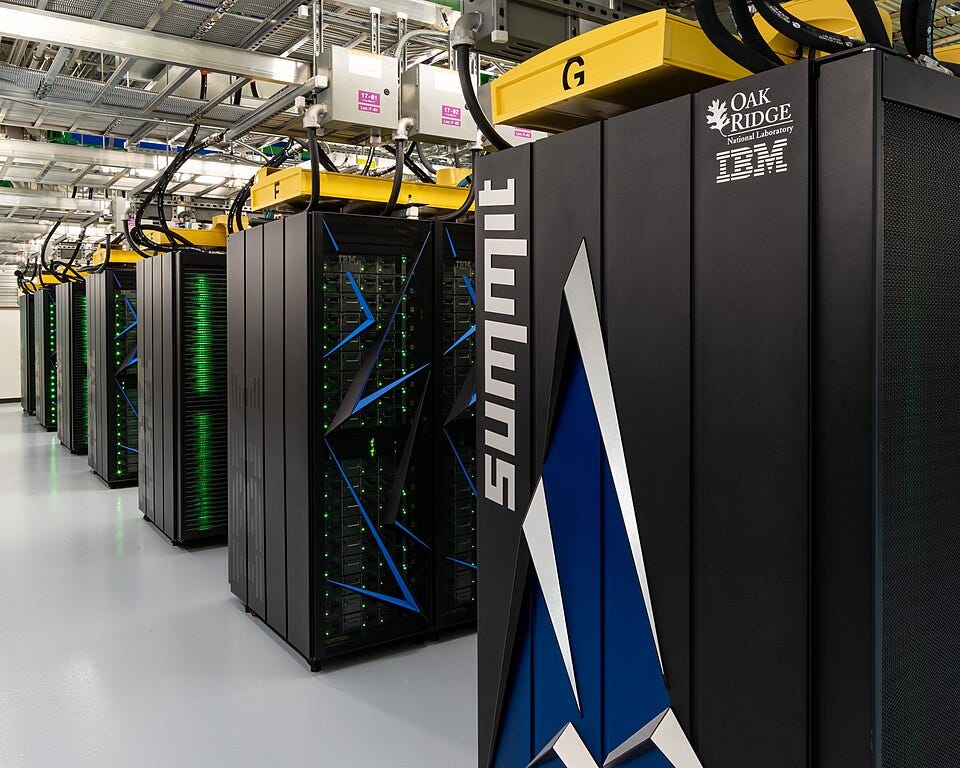
In some sense, we attained quantum supremacy back in 2019, when Google researchers published that they had been able to run a calculation that would require over 10000 years on the best classical supercompter in just two hundred seconds on a 53-qubit quantum computer. While this claim apparently passed Nature’s “rigorous peer-review process” and was published there almost word for word, IBM soon rebutted it, stating that the effort on their state-of-the-art classical supercomputer would only take a few days. In spite of that being the case, though, Google’s result remained impressive. It still demonstrated that quantum computers of moderate dimensions were already able to accomplish tasks that still took days for the most advanced, complex supercomputers.
Such a promising result spurred speculations about its practical implications. Early stage investors avidly bought stakes in startups with a quantum computing imprint, based on the silent assumption that soon, every aspect of the economy would need to use quantum computers. However, Google’s trailblazing paper was construed around a very specific, non-practical problem, that the researchers deemed most suitable to demonstrate quantum supremacy. From a purely scientific perspective, they were right and they did a great job. Since the problem was highly theoretical in nature, it turned out to be a very big leap, though, to crystallize any of the demonstrated quantum advantage into practicable solutions that benefit the economy. As soon as the dust settled, investors’ enthusiasm for quantum became more lacklustre.
While we entered a less glamorous phase of growth for quantum computing, science continued to develop. Fast forward to 2026, and we have another breakthrough, in two papers, one of which is again co-authored by Google scientists. The papers have sparked a social media hype in tech circles and have spurred claims like “we need to reshape our digital security architecture by 2029.” While the papers themselves refrain from making such hyperbolic statements, not only the papers, but also the pompous claims, are based on a layer of truth.
(If you agree that Wild Horse Wisdom is based on a layer of truth, consider to subscribe. There is a free tier.)
In today’s digital landscape, one does not have to have deep technical expertise to run into terms like “RSA.” In fact, tools like RSA are mainstay components used in cybersecurity, such as secure browsing (e.g. “https://” web addresses), digital signatures, secure e-mails, virtual private networks (VPN) and more. RSA is based on factorization of large prime numbers, which is an untractable problem on classical computers, that thereby provides inherent security. However, back in 1994, Bell Labs’ visionary scientist Peter Shor published an algorithm for prime number factorization on quantum architectures. It was the first algorithm to promise a practical quantum advantage: it could be used to solve a problem that is notoriously hard on classical machines, while it would only require polynomial (i.e. “doable”) scaling on a quantum computer.
Shor’s algorithm has existed since 1994, but has so far never been a threat to cybersecurity solutions, because no suitable hardware existed to run it on. Howbeit, that is exactly what seems to be changing. Even more explicitly than Google’s paper, a recently published preprint by Californian scientists claims that Shor’s algorithm may be “possible with as few as 10,000 qubits.” Given that in 2019, Google provided its best-possible solution to demonstrate quantum supremacy based on just 53 qubits, a 10,000 qubit quantum computer should be far off into the future, right? Well, actually, in 2025, the largest quantum computer was reported by CalTech … to consist of 6,100 qubits. At the present rate of development, we may well have 10,000 qubits by 2029, which would mean that just in three years from now, cybersecurity as we now know it, will break.
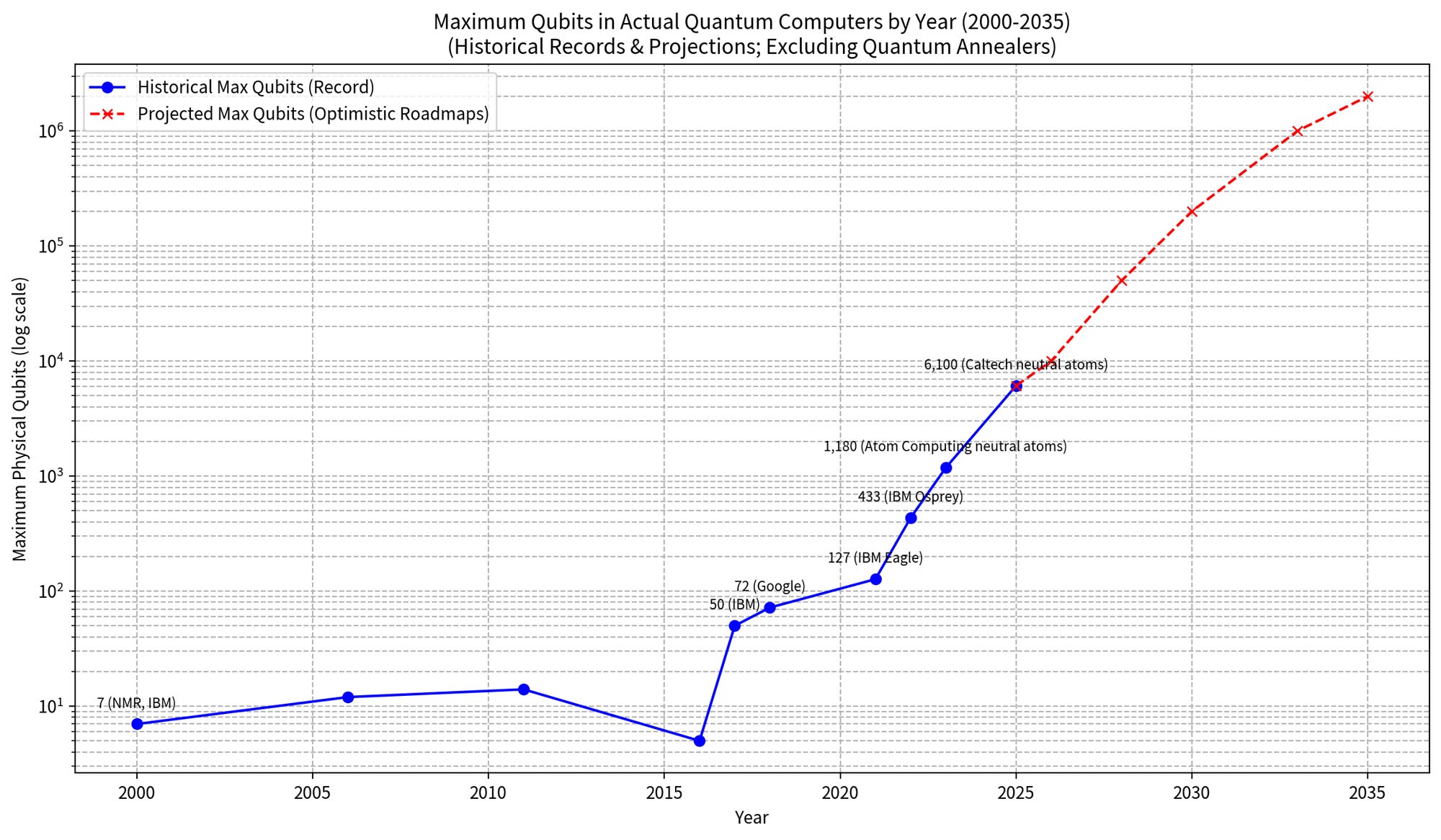
If present-day encryption will break in 2029, that means that we will no longer have secure connections for any application that needs them. Previous estimates of when exactly quantum computers will be able to use the advantage of Shor’s algorithm went into 2050, which would give governments and corporations ample time to adapt. If Shor’s algorithm becomes reality in 2029 indeed, we are unprepared.
In the light of the possibility that present day cybersecurity will be unreliable in just a few years, it seems rather ill-advised for governments and “think tanks” to be pushing for an “all-digital” world, in which credentials are presented exclusively through digital IDs, payments are made exclusively in digital currency and much more. Even in today’s online landscape, it is questionable to upload some of our most sensitive information into a centralized government data base, let alone in a world where quantum computers are able to break classical security. Such a setup is a straight road to identity theft on steroids, as has already been demonstrated in Nigeria.
If all payments become digital, they either transact in central bank or private digital currency. In the US, the trend seems to go in the direction of stablecoins, which have received much broader acceptance since the GENIUS Act was signed into law. Well, stablecoins are cryptocurrencies that are backed by government securities and that transact on a blockchain … which on its turn, is based on encryption standards that depend upon prime number factorization … and ergo, can be broken by quantum computers. Exactly with that thought in mind, the Google paper mentioned before was co-authored with authors from the Ethereum foundation and one of its research goals was to evaluate if quantum computers are able to break the security of transactions on Ethereum blockchains. The answer was “yes” and the paper urges blockchains to adopt “post-quantum cryptography (PQC) “without delay:”
“We also discuss implications for other digital assets and tokenization as well as challenges and successful examples of the ongoing transition to Post-Quantum Cryptography (PQC). Finally, we urge all vulnerable cryptocurrency communities to join the migration to PQC without delay.”
Babbush et. al, arXiv:2603.28846v1
However, blockchains are not the only services that need to adapt to PQC. A recent review assessed the readiness of the private sector. It stated that only a sobering 8% of the top-1 million websites support PQC. Moreover, in their analysis they stated that:
“Banking stands out as a surprisingly weak adopter of PQC, with just 4 out of 145 identified banks (2.9%) supporting post-quantum ciphers.”
David Warburton, Director, F5 Labs
As to government institutions, let’s assess one of the best prepared ones, which is the United States Government. While the U.S. federal government has forged robust policies and mandates to confront the looming quantum threat—issuing directives, embracing NIST’s post-quantum standards, and setting ambitious migration timelines, significant cracks remain visible in the foundation of execution. Authoritative analysis from the Government Accountability Office, particularly in its June 2025 testimony, reveals that federal agencies have yet to fully define a comprehensive national strategy for addressing quantum risks to cryptography.
Summarizing, it seems that we’re well prepared as a society, right? Given that cybersecurity may soon be broken, it also seems highly dubious to be advocating for digital IDs and digital-only payments in a society that functions very well without them. This is not only a Wild Horse Wisdom opinion. Even AI agrees. When prompted Grok AI with the question if it is a good idea to roll out digital ID in the light of the two recent papers, Grok answered:
“No, rolling out large-scale digital ID systems right now—without strong post-quantum cryptography (PQC) baked in from the start—would be risky and shortsighted, especially given the narrowed timeline from Google’s March 2026 paper.”
Grok
That’s right, Grok. So let’s prepare ourselves. On the one hand, yes, we have to accelerate deployment of post-quantum cryptography. But at the present pace of adoption, there is no way we will be prepared on a society-wide level by 2029. So let’s also be prepared for the doom scenario. The best way to do that, is by having a physical equivalent available for any digital transaction. Let’s legislate that, for any transaction, an option based on physical goods always needs to be available. No more “cashless only,” or even worse “contactless only” resorts or businesses (what exactly is wrong with contact?). Let’s also say bye to QR code access without alternatives. When cybersecurity breaks, QR codes break too, but the will-call booth somehow does not. At least not if they also have a printout of the attendee list.

Here at the Ranch, we do use contactless payments from time to time. But we also get annoyed at parking lots that no longer have a machine to pay by credit card and make us waste our time, as we need to fill out endless online forms “for our convenience.” Nonetheless, we really believe in physical assets and we don’t overestimate the quality of futuristic solutions. We are not sure that our horses will win a competition. But we know that they stand a chance. Yet we can say with absolute certainty that the spherical horse in vacuum will never win a race.
Politicians of various stripes around the world are involved in what seems to be a concerted attempt to abuse the emotional appeal to "protect children from online harms" to push a digital ID and surveillance architecture not needed at all to protect children. They are doing so at a time that could not be more ill-advised.
In the US, representative Josh Gottheimer (D-NJ) introduced legislation that would force identity verification for all users at the operating system level. One wonders how doing so is not more racist than requiring an ID to vote.
EU Commission president von der Leyen on her turn announced that the EU is now "ready" to deploy digital ID. She introduced an app to be piloted by six countries.
After just two days, cybersecurity analysts found fatal flaws in the EU's app, stating that it can be hacked in just ... two minutes:
https://reclaimthenet.org/eu-age-verification-app-hacked-in-two-minutes
The EU's digital ID app can be hacked in just two minutes by humans.
Should we ask how fast it can be hacked by AI or how future-proof it is against hacking by quantum computers?
We never needed digital ID and now is the worst possible time to roll it out. We need to pause these efforts indefinitely and globally.
That was very interesting, I vaguely knew there is a problem with encryption and quantum computing but you explained very well how it works.