

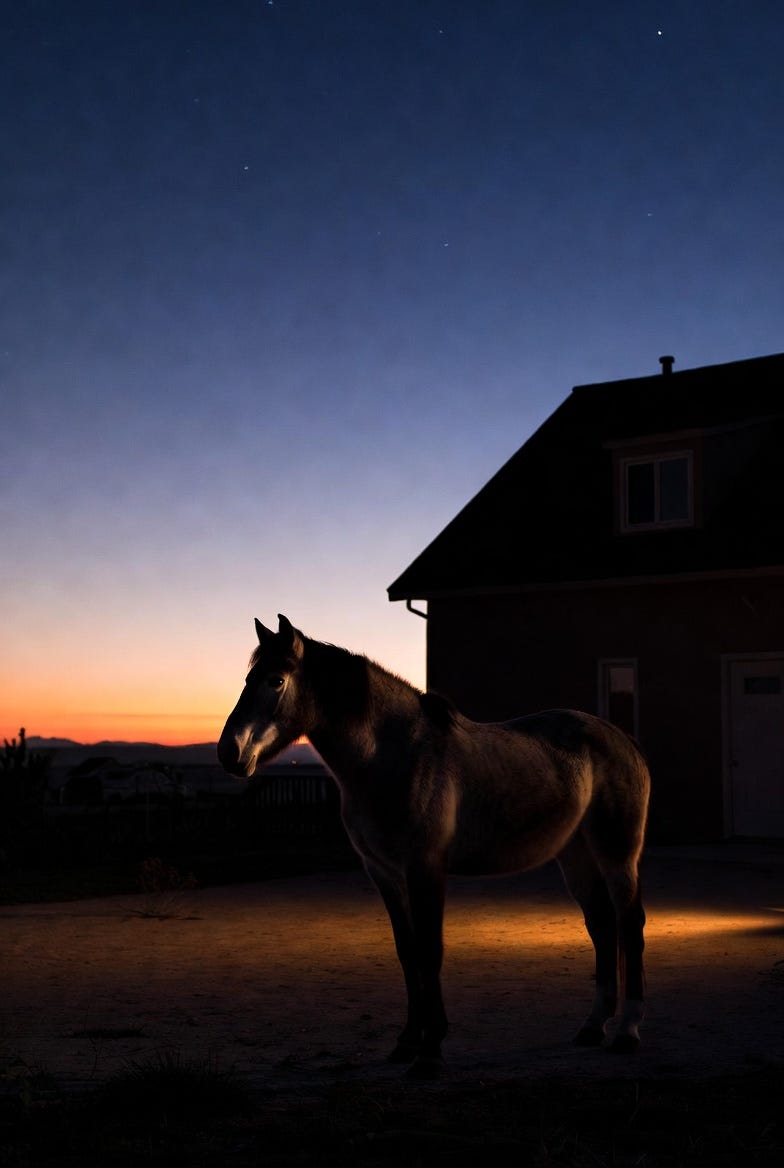
In these areas, the weather can be pretty capricious. It isn’t uncommon to have springlike weather in the morning, to then see a black wall of clouds approach and temperatures plummet into the deep freeze within no more than an hour. We are used to that, but then, hey, we are prepared for it. We have resilient power and gas grids over here. Or at least that’s what we thought until last week. One of the usual black walls approached. Everyone was indoors, we horses all in the stable. It was going to be a cozy night. Until the lights went out, that is. Not only the sky, but everything went dark for the remainder of the day. We wondered what had happened, but we wouldn’t be finding out before we had juice again. A spooky experience indeed.
Once the blackout was over, we did some internet research. We wanted to know if other regions experienced the same and if authorities were taking efforts to prevent it from happening again. It turned out that Spain went through a very similar sequence of events. It’s not a country we usually hear much about, but maybe we should.
On Monday April 28, 2025, Spain and much of its neighboring country Portugal experienced a widespread power blackout. The official investigation into what has happened is still ongoing. European grid authority ENTSO-e has released a preliminary report that traces the course of events, but a full blown root cause analysis is still pending. It should be in everyone’s interest to learn the root cause of such a major blackout, even to residents of countries far away from the Iberian peninsula. Nobody likes to be caught in a power blackout and any grid operator can learn from a thorough analysis of events. Therefore, this incident should be a prime candidate for a calm and objective analysis. Nonetheless, it was politicized from the first minute.
Certain experts and a fair share of the affected communities soon pointed to “renewables” as the cause of the blackout. Spanish Prime Minister Pedro Sánchez did not deign to wait for a thorough analysis of the events, either. When confronted with the potential role that “renewable” energy might have played in causing the blackout, he bluntly rebutted such allegations as “lies” and warned against the “spread of disinformation.”
The crucial function of having a reliable power grid does not seem to preempt it from political speculation. With “renewables” being a topic tethered to the highly politicized field of “climate change,” a thorough analysis of the course of events did not seem to be necessary for most, who had already picked a side beforehand. Just like in highly politicized criminal cases, all the ones who were already on either side of the political fence knew the culprit before the investigation even started.
The official investigation by ENTSO-e is still ongoing, but a lot of information is publicly available. We have operational data from the grid, along with the course of events published in ENTSO-e’s preliminary report. And then there is the official report by Spanish grid operator REE, which arrived at a conclusion independent of the regulatory body at the European level. What we do know is that a sudden, localized voltage increase occurred in southern Spain, which on its turn caused a frequency decrease in the network, a major oscillation and a cascade of generation losses. The figures below illustrate this very well for a section of the Spanish grid.
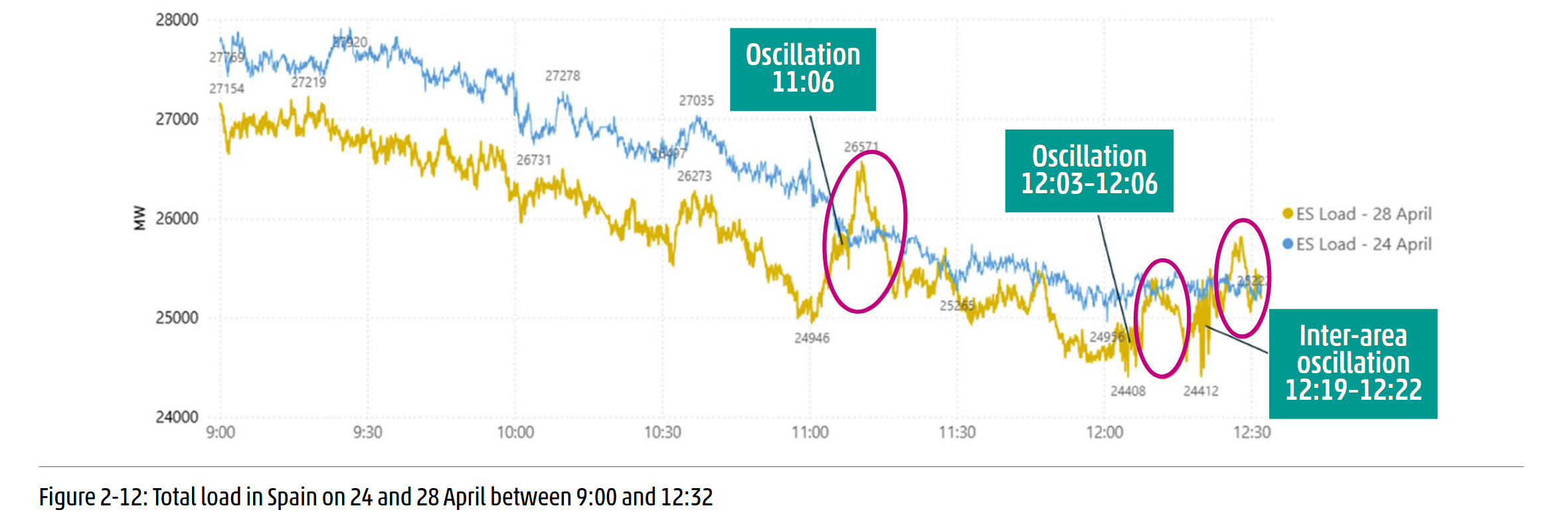
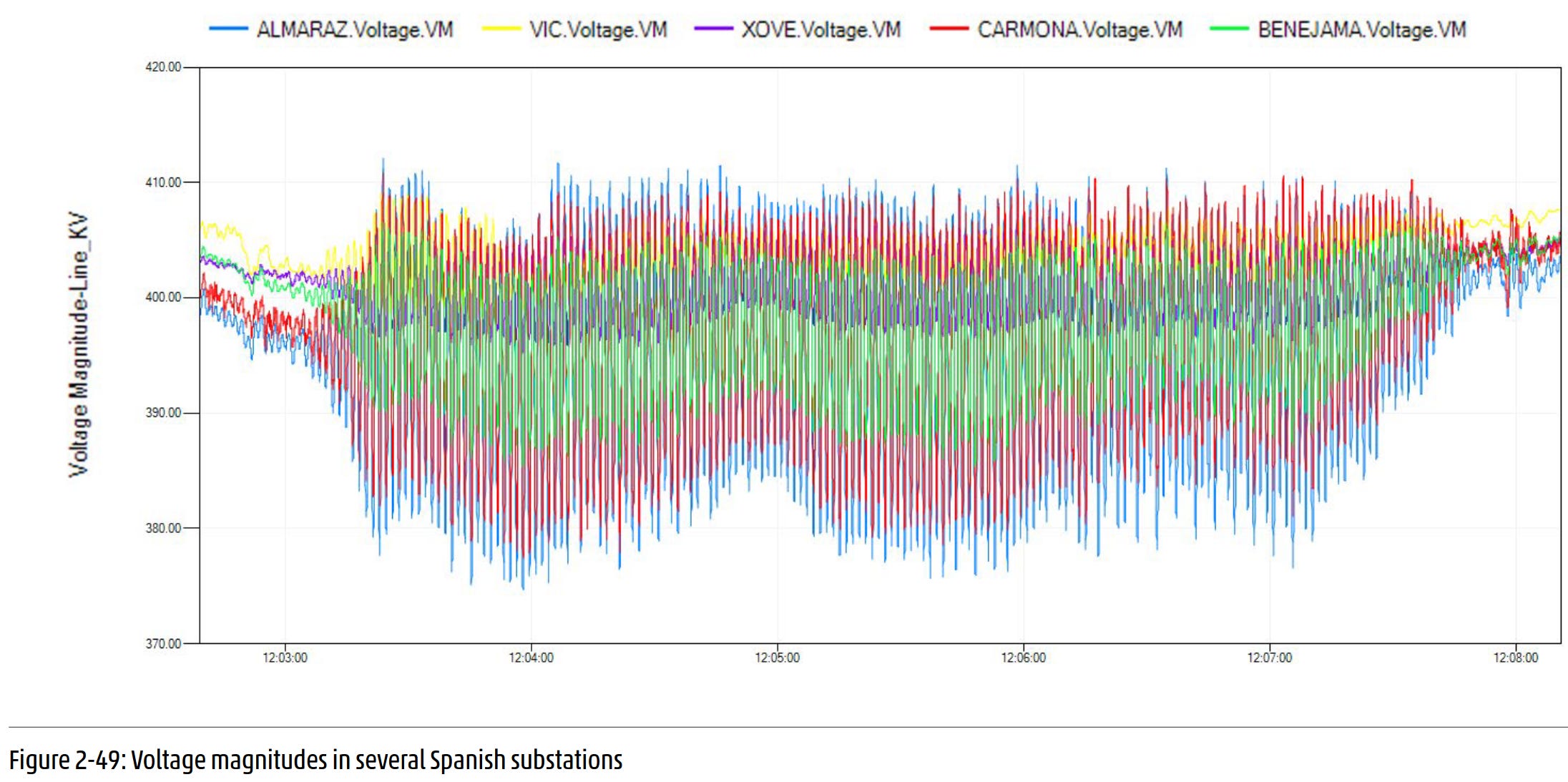
Preliminary conclusions from REE’s report point to non-adherence to voltage control regulations as a cause for the incident. It is true that sufficient generation was online at the time of the event and that the blackout was the result of power generation disconnecting in reaction to the initial overvoltage. Some of the resources that disconnected were thermal generation units. On the other hand, though, it is also true that the initial overvoltage did originate from a solar facility. Why that happened is still unclear.
While it is difficult to point to “renewables” as the sole cause of the event, it is equally unsound to dismiss the impact they had. The original voltage spike originated from a large solar facility. It is also true that, at the time of the outage, over seventy percent of Spain’s grid ran on “renewables.” A fundamental difference between “renewables” and conventional power generation, is that “renewables” do not intrinsically generate alternating current at a certain frequency. One can understand the latter intuitively when considering that conventional generation units consist of large spinning devices, the rotation frequency of which determines the frequency of the power generated. When an issue arises in the power grid, the inherently slowly changing rotation frequency of such devices ascertains stability of the corresponding frequency in the power grid, which is also referred to as inertia. Renewables do not provide such inertia. Instead, they generate direct current, which is converted to whichever frequency the grid is at by a device called an inverter. When grid frequency fluctuates, these inverters will follow the grid and thereby amplify the problem. We can readily observe that a large oscillation took place around the time of the outage. That said, it is not clear that the event would have been prevented if more inertia had been present. From this angle too, it is both foolhardy to attribute the entire incident to lack of inertia, as well as to dismiss the fact that renewables make the grid harder to manage in such a situation.
The presence of inverter based resources does come with additional challenges to ascertain grid stability. That is widely recognized, also outside Europe. The North American Energy Reliability Corporation, or NERC, is the regulatory body for grid operators on the Western side of the North Atlantic. NERC writes standards and guidelines for power grid operators and interconnection authorities. Like ENTSO-e, it also assesses outages and other events. Moreover, as its name suggests, its primary function is to ascertain energy reliability. In that capacity, it identified inverter-based resources, or IBRs, as a potential destabilizing factor for grid operations. In 2022, it issued an IBR Strategy that analyzes how to deal with an increased share of those.
NERC’s primary function is to safeguard energy reliability in North America. As such, it publishes Long-Term Reliability Assessments (LRTA) for the power grid, at the level of the sundry interconnection authorities. Its 2025 update does not depict a rosy picture. In fact, it uses very polite language to state the fact that it will be difficult to avoid blackouts in North America if we keep making the power mix more susceptible to weather conditions and keep making grid stability more challenging due to an increased share of inverter-based resources, while facing a steeply increasing demand from data centres and other developments. In NERC’s words:
“The overall resource adequacy outlook for the North American BPS is worsening: In the 2025 LTRA, NERC finds that 13 of 23 assessment areas face resource adequacy challenges over the next 10 years. Projections for resource and transmission growth lag what is needed to support new data centers and other large loads that drive escalating demand forecasts. Most new resources in development to come on-line in the next five years consist of battery storage and solar photovoltaic (PV), which are inverter-based and weather-dependent resources that increase the complexity of planning and operating a reliable grid. Meanwhile, more fossil-fired generator retirements loom in the next five years, reducing the amount of generation that has fuel on site and impacting the system’s ability to respond to spikes in demand. The continuing shift in the resource mix toward weather-dependent resources and less fuel diversity increases risks of supply shortfalls during winter months. [emphasis added]”
NERC - 2025 Long-Term Reliability Assessment, Executive Summary.
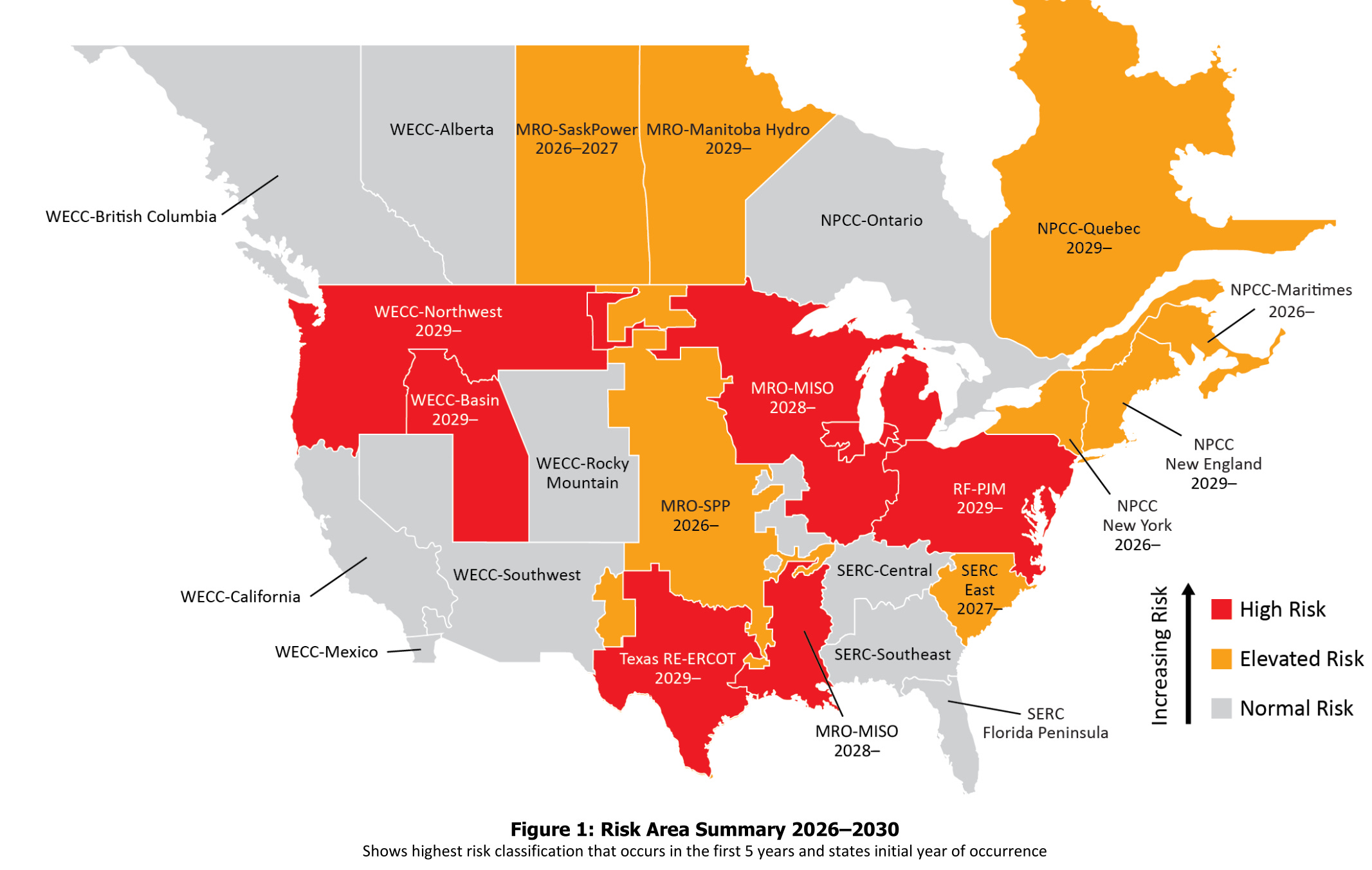
NERC supports these statements with a detailed analysis by regional power pool. The resulting plot needs little comment: many areas in North America are deemed “at elevated risk” to see a power shortage, while a considerable amount of them are even at “high risk.” The latter notably include densely populated areas, such as the one served by PJM Interconnection (the acronym is short for Pennsylvania, Jersey and Maryland, although the interconnection authority also covers some areas in Illinois). In spite of the Iberian peninsula blackout having occurred during the spring in a region with a mild climate, eight deaths have been reported as a direct consequence. One can only wonder how plenitudinous fatalities would be, if a severe power shortfall occurred during a winter storm in area like PJM.
In a reasonable, apolitical environment, we would treat grid stability as the north star. However, much of the situation we are observing is the result of reckless politicized policymaking tied to an antiscientific agenda of “net zero” energy generation. By massively subventioning so-called “renewables” and penalizing all forms of thermal generation, we have needlessly endangered grid stability. It is now time to return to reason. A first step must be an immediate and unconditional end to all forms of subsidies for “renewables.”
Besides stopping the subsidies for “renewables,” we should also stop referring to them by that term. The quotes around the term “renewables” applied in this article are appropriate. Solar panels last thirty years, at best, while their inverters need to be replaced around half-life. Moreover, manufacturing them actually consumes high amounts of energy and recycling them is very hard and therefore, not profitable. Hence, most solar panels end up in landfills where they gradually leak toxic chemicals and heavy metals. They actually already do so before they end up in the landfill. Since the panels themselves are polluting, it does not seem to be a good idea to cover large areas of land with them, neither in a landfill, nor elsewhere. It also seems a stretch to designate one-way, polluting panels as “renewable.”
Wind farms are even worse. While manufacturers claim that windmills have a twenty-five year life-span as well, operators report far lower figures. Many windmills are being replaced after a mere seven to ten years. Add to that that, also in their case, the blades are almost impossible to recycle. The result of that are wind blade graveyards, such as the ones that can easily be spotted from a plane in West Texas. So far, the best attempt at “recycling” wind blades comes from Wyoming. If we take “recycling” with a pinch of salt, that is. The Wyoming Department of Environmental Quality (DEQ)’s proposal to “recycle” wind blades consists of grinding them and using them as material to fill empty mine pits. To the critical listener that may very well sound like greenwashing landfill operations.
These facts alone should put in question whether wind farms really do anything that is “renewable.” But we should also take into account that they consume massive amounts of land (or ocean surface) that cannot be used for anything else, are not even thirty percent reliable, are hideous eyesores and kill massive amounts of birds, bats and marine life, a fact that is gradually even being accepted in mainstream scientific literature. If we do so, we can only land at one conclusion: wind is maybe suitable in individual, small-scale applications, but it must not be pursued at all as a component to supply a sizeable share of any region’s power demand. In fact, disincentivizing wind is the right way forward, for instance by imposing a tax for the environmental burthen, the money of which can be used to pursue truly clean alternatives.
It is time to return to reason and plan for a reliable future for the power grid. That inevitably requires investment in energy-dense, on-shore, reliable power generation. Further legislative steps have to be taken to provide economic stimuli for those energy sources that provide a stable, reliable supply for the long term, while intermittent, unreliable sources have to be discouraged going forward.
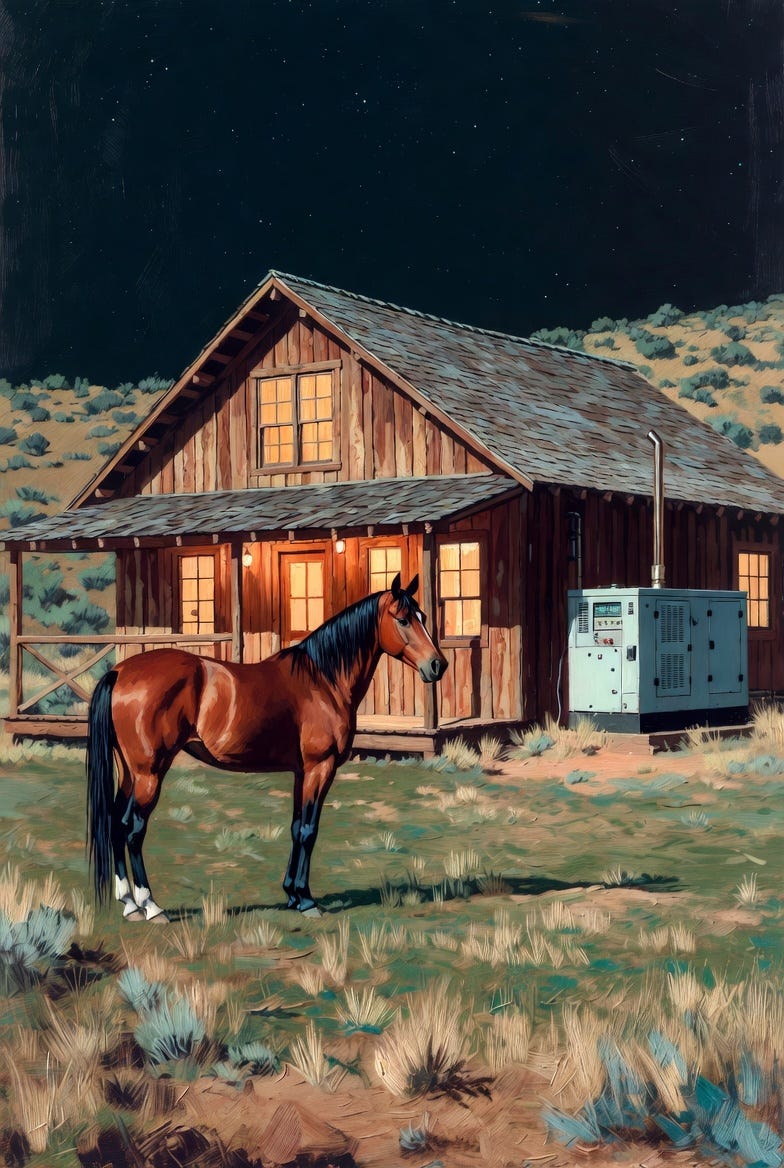
Remember the horses that were placed in a treadmill at Six Hooves Ranch? We laughed at them at the time over here, but it seems that they had a point, though. We also learnt our lessons from the blackout. We didn’t install a trommel for our horses to run in, but the emergency generator now sits firmly right next to the ranch house.
Evergy is one of a growing list of utilities who have come to realize that energy-dense, reliable power generation is the only viable way forwrad. It has cut wind entirely from its planning and most solar as well:
https://sarahmontalbano.substack.com/p/when-utilities-need-power-they-can
Evergy identifies the loss of the production tax credit under the One Big Beautiful Bill Act (OBBBA) as a direct “driver of the reduction in renewable resource selections.” In other words, solar and wind were only "so cheap" as long as the subsidies lasted ...
After a lost decade of failed energy policy, wasting erstwhile beautiful landscapes and seabeds with the ecological nightmares of solar and wind that are neither cheap nor 'renewable,' the European Union has now discovered that it can also build reliable, energy-dense, on-shore power generation:
https://www.theepochtimes.com/world/eu-sets-strategy-to-deploy-small-modular-nuclear-reactors-by-early-2030s-5996608
The latter is all we need. The European U-turn is long overdue, but better lat than never. My prediction is that more European U-turns will follow on other topics where they are presently erring in deep darkness.