

We recently made another trip out east. There’s always something out of the ordinary that happens when we’re out there. This time though, I experienced it for myself. When we got out of the pony trailer, we walked into our pen. Everything looked normal there, but then I saw a brand new building with an opening in it. At fist, I thought it was a stable. Yet when I walked in ... I found myself in the men’s room!
When Jake entered, I gave him the scare of his life. Of course, he didn’t expect to find a horse in the restrooms. He walked me back out and didn’t wait a minute to share the story. He was even more baffled, though, when he saw that there was no door to be closed on the restroom building. “Why on earth would they make a men’s room that has an opening into the stables?” I heard him say. That was before he found out that all the stables had access to washrooms.
A few casual chats were enough for Jake and Bob to learn why these buildings had been designed so oddly. Per Oceanland State Law, any stable constructed after 2025 needed to have access to human conveniences. They had codified this rule in reaction to a scientific publication that claimed that horses have an eighty percent higher likelihood of committing suicide if they are banned from using human facilities.

Horses are very grounded. They feel well in their bodies as they are. We had never heard of a horse that committed suicide, but if it is true according to the science, true it must be, right? Pretty much the same can be said about a paper on humans that recently did get published, and its legal ramifications.
The paper State-level anti-transgender laws increase past-year suicide attempts among transgender and non-binary young people in the USA by Lee et al. has been cited as the “gold standard” in lawsuits that challenged state laws banning transgender practices, such as the use of female restrooms by people who have a Y chromosome. In fact, attorneys seeking to overturn “anti-transgender laws” cite the paper as “proof” that enactment of such laws would lead to a “seventy-two percent” increase in suicides among “TGNB” (i.e. transgender and non-binary identifying) youth.
If the paper had just silently been published in the scientific literature, we might have let it be for what it is. A lot of papers that make outlandish claims can be found there. Yet since this paper is being used in judicial proceedings, a more detailed inspection is called for.
The first thing that stands out upon inspection of the paper is: the list of authors and affiliations. In fact, all authors are affiliated to the Trevor Project, which is a West Hollywood based charity that promotes … transgender rights. If one expected the authors to have certain preconceptions about the subject, one would not be mistaken. In fact, before describing any scientific results, the article sets off by stating that
“[…] anti-transgender laws may signal a broader societal rejection of their identities, communicating that their identities and bodies are neither valid nor worthy of protection.”
Lee et al., Nature Human Behavior, 8 (2024), 2096–2106.
Objective observers will spot that there are a few missing links between the need for “trans people” to use sex specific facilities and their entire bodies being “invalid,” yet that link seems to be obvious to both authors and referees. A few paragraphs later in the introduction, we read that “gender-affirming care has well-established benefits.” Some references are cited with this statement, but none question the subsumed “benefits.” To only cite references in favour of one’s own opinion and conclusions is bad scientific practice. In fact, for this statement alone, the paper should have been sent back for the authors to revise, since ample scientific literature exists that attests to the opposite. For instance, a study from Sweden has concluded that people who undergo sex reassignment procedures are actually more likely to commit suicide later in life. Note that the authors also —misleadingly— refer to such procedures as “gender-affirming care.”
Notwithstanding the bias in the Introduction, the article proceeds by presenting the analysis. In a nutshell, what it reports is the following. Data have been recorded from questionnaires in five yearly waves from 2018 through 2022. In these questionnaires, participants would answer a set of demographic questions, followed by 142-150 questions specific to the subject (some questions were added in later years). The paper only retained those subjects that both classified as TGNB and age 13-24. Separate from the questionnaire, the study gathered data about the state and year in which “anti-transgender laws” were enacted.
The paper then proceeds by fitting a difference-in-differences (DD) model. Such models are common in disciplines like econometrics. They assess if a certain intervention has had an impact on an economic outcome and essentially do so by comparing the difference of the difference in outcome to the prior year across regions evaluated. In layman’s terms, in this study the DD models establish if the difference (read: increase) in risk of self-harm compared to the previous year is any different in states that have enacted anti-transgender laws from states that have not. The authors report that there is a significant increase of risk of self-harm in places that have enacted such laws. They report an increase of 7-72% in past year suicide attempts compared to states that where no “anti-transgender laws” were enacted. The authors see the result of their analysis as a motivation to “advance protective policies.”
Off of the face of the published text, one could be inclined to believe that “anti-transgender laws” indeed have pernicious effects. Yet this paper is mainly about statistical data modeling, so it is no exception to the old adages that abuse of statistics can provide evidence for about any statement and that models are never better than the data they have been fit to. In this case, the latter seems to be the weakest link. The authors have publicly stated that their application of statistics is state-of-the-art. It is always possible to fit different types of models to the same data, but since the DD approach is commonly used in econometrics, there is no obvious need to criticize their approach to statistical analysis.
Good science reflects in a good choice of models. But it also needs to be reproducible. If the paper truly were state-of-the-art, it would publicly disclose data and provide code that allows the reader to reproduce the results. Unfortunately, the paper fails on both accounts. In fact, the data are the result of questionnaires conducted by the Trevor Project itself. Although they have been “independently audited,” that fact alone should raise questions on a topic as sensitive as this one. Moreover, in the “Data availability” statement, the authors state that they will not disclose the raw data publicly, and will only share them with “accredited researchers who have received ethics approval from their institutions.” At this point, note that the Trevor Project is not an accredited institution itself. The statement is clear enough, though. It can be translated to “we will only share data with people who we deem to be sufficiently woke.”
Since it is impossible to access the raw data, we can’t help ourselves to ask the question if there aren’t any other ways to check the results presented in the paper. For instance, how about we find data that are a stronger indication than the ones analyzed by the authors? They investigated risk of self-harm based on what interviewees reported in their questionnaire. So what happens if we look at actual suicides, instead of only reported intentions? If all the “trans kids” became suicidal, shouldn’t we see a sharp increase in the number of suicides? Most of all so after 2020?
To answer that question, we visit the Centers of Disease Control and Prevention’s Web Based Injury Statistics Query and Reporting System (WISQARS). The CDC’s database conveniently provides time series of injury statistics of all sorts that can easily be filtered for suicides stratified by age or state. To the downside, WISQARS does not keep track of the type of mental issue victims of suicide were known to have before they committed the act, so there is no information neither on pre-existing conditions, nor on “gender identity.” However, each data point in the WISQARS data base corresponds to an actual suicide reported by an expert, which is a much more reliable data source than the Trevor Project’s self-reported questionnaires.

A plots of the nationwide age-adjusted suicide rate, directly drawn from WISQARS, is shown above. On a nationwide level, youth suicides (age 0-19) seem to have been constant in the 2000s, to then precipitously increase throughout the 2010s. They peaked around 2017, since when they have been decreasing again. From this plot alone, one would be willing to accept that widespread adoption of social media has been a driver for youth suicides. In fact, there are other publications supporting exactly that hypothesis, such as Twenge et al. (2017). However, it would be difficult to ascribe any of this trend to the enactment of “anti-transgender laws.” Before 2020, children were still taught the inalienable truth that they are always born in the right body, so approximately exactly none of them identified as “TGNB.” Also, anti-transgender laws were largely enacted after 2020, in which time we observe a decrease in suicide rates.
The publication by Lee et al. did not look at nationwide aggregates, but focused on differences between states. So, if the 72% increase in tendency to self-harm reported by them is material, we should also see a big difference in by how much suicide rates have increased when comparing states. They should have increased much more in deep red states than in blue ones, shouldn’t they? In Figure 2, we plot suicide rates as a time series in two red states with recently enacted “anti-transgender laws” (Idaho and Texas) and two blue states with pro-transgender legislation (California and New York). Do we see a difference in increases?
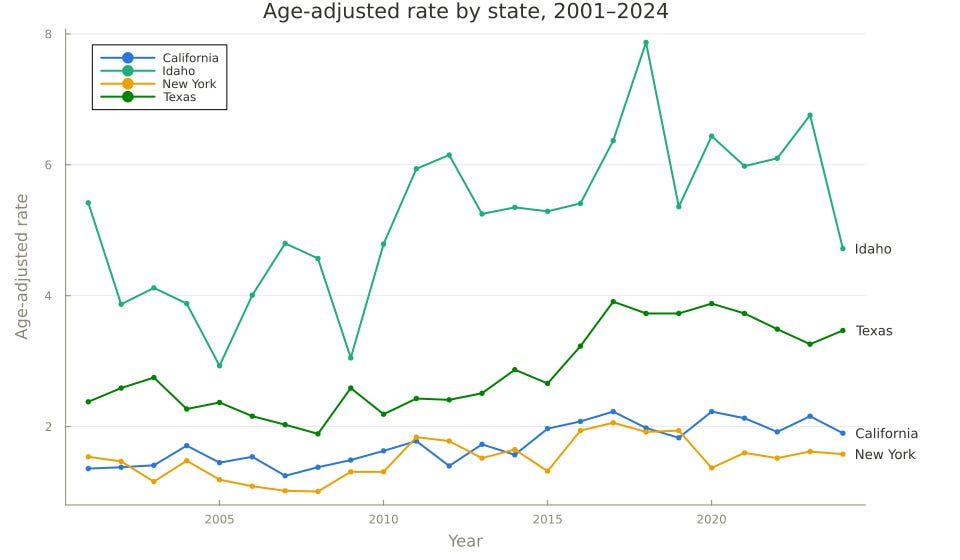
Regrettably, Idaho and Texas have much higher youth suicide rates than California and New York. However, they have been having those rates for the entire length of the time series. Therefore, it is impossible to attribute those to transgenderism or laws against it. The main effects of anti-transgender laws should be obvious in the 2020s. However, for both Idaho and Texas, we actually observe a decrease in youth suicides in recent years.
Lee et al.’s conclusions may be well founded if based on their own data. However, real world evidence does not support any of their hypotheses. At this point, one has to wonder how come neither the journal editors, nor any of the reviewers spotted flaws in their data collection process and asked for data independent from the Trevor Project? After all, Lee et al.’s paper is pretty much analogous to Pfizer authors publishing an article that “proves” their new drug to be “safe and effective” based on data and research they generated themselves and are unwilling to disclose to third parties. Such behaviour would not pass review almost any other field. However, it suffices to just take a look at what kind of other papers are published in Nature Human Behavior and we know the answer. On less politicized topics, some honest publications seem to have appeared there. Yet merely screening the titles of some of the publications that appeared around the same time as Lee et al. shows a clear picture: on any politicized topic, the journal is a country club of the believers in the anti-religion of woke scientism, whose supreme purpose in life it is to have their beliefs confirmed by churning them out in a format intended to look like science. Let’s always remember that neither the language in which a paper is written, nor its page layout, are attestation to it being a report of research that follows the scientific method.
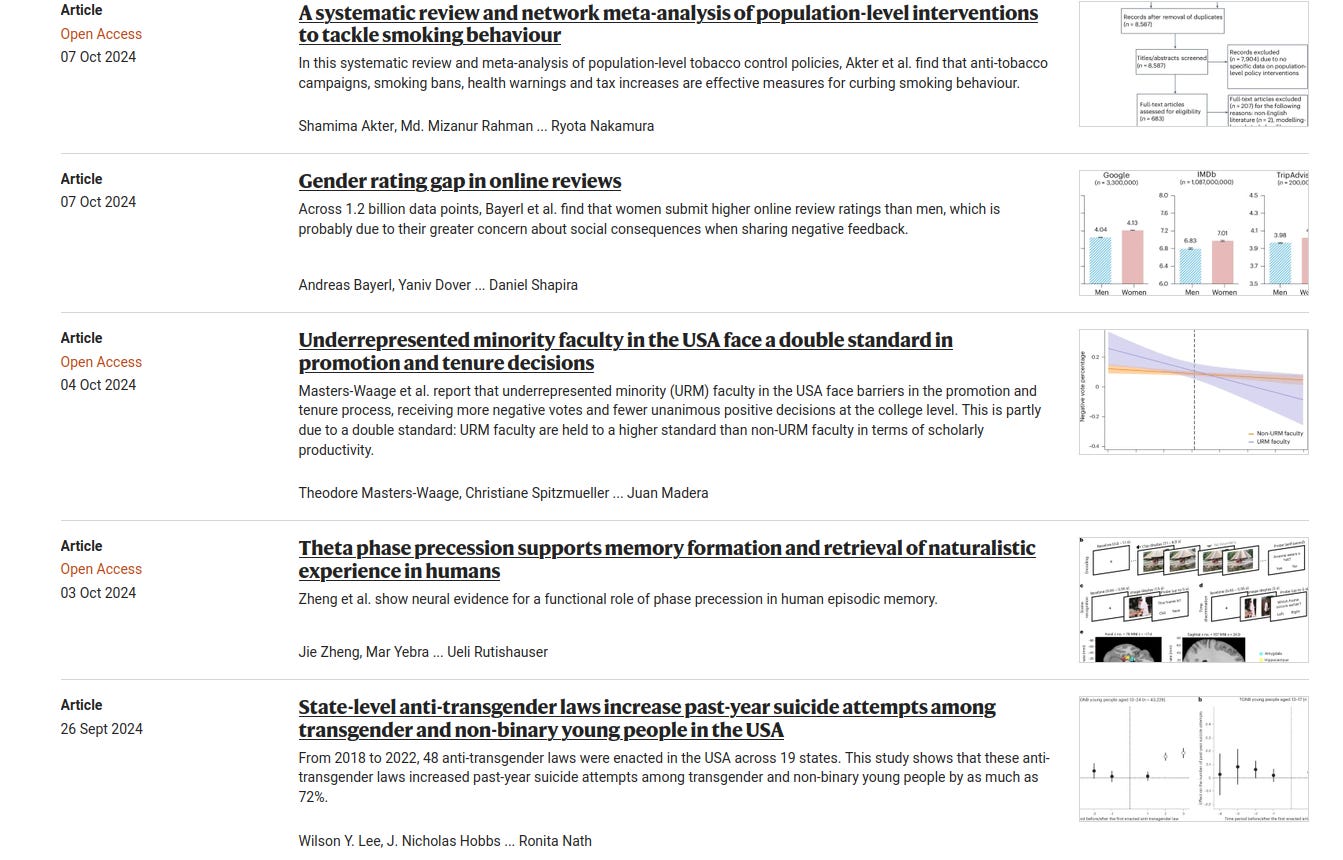
In fact, our conjecture is that the authors pretty much did the opposite of what the scientific process requires. They may well have started their paper by writing the title: State-level anti-transgender laws increase past-year suicide attempts among transgender and non-binary young people in the USA. It appears that they then collected data and built models in support of that title, to eventually write it up in format with scientific optics. In that sense, this paper is no different from some papers we reported on before, such as papers on the (inexistent) deadliness of moderate alcohol consumption or the (equally inexistent) carcinogenic effect of red meat.
Apart from their scientific practices, it also seems questionable why the Trevor Project invests the time and resources to conduct research like the one published by Lee et al. As per their homepage, “The Trevor Project is the leading suicide prevention and crisis intervention nonprofit organization for LGBTQ+ young people.” If so, one should wonder if publishing opinions dressed up as science really leads to suicide prevention. Instead of writing papers, the Trevor Project would most likely have much more success at reducing youth suicides if they spread the absolute truth that all youths are always born in the right body. That reassuring message alone should help assuage suicidal tendencies. If they take their own mission seriously, the Trevor Project should promote amplification of that message and provide psychological support for youths who fail to recognize that divine truth.

We’re back here at the Ranch. I like my own pasture and stables. It was an interesting experience, though, out east. I had never been in a human bathroom before. It didn’t feel different to take a dump in it than in my own stables. I still wonder who mucked the bathroom afterwards…
If you like this article, please help us stimulate Substack’s algorithm by becoming a free subscriber and/or clicking the ♡ button.