

Cowboys Jake and Hunter were trimming some weeds on the Ranch house lawn. They discussed many things, but as the afternoon went on, they got worried that Bob and the children hadn’t yet returned.
“We’ll fire the smoker up,” said Jake, as the sun started setting, “so Bob can have his steak right away when he’s back.” Soon enough, white smoke stopped coming out and the smoker was at perfect temperature when eventually, Bob and the children pulled up the driveway.
“What took ya so long?” Hunter wanted to know.
“We had to stop for five different security checkpoints.” Bob replied. “Each one took at least fifteen minutes to get the all clear.”
“Five checkpoints? That’s insane! What were they looking for?” Hunter asked in amazement.
But Bob did not let him wait: “They wanted to see everyone’s ID each time. They had been instructed to make sure that no children were using AI in the back seat.”

Maybe we will not see such checkpoints too soon. Or perhaps we will. Either way, politicians of many stripes in several countries all of a sudden seem to think that artificial intelligence is a reason to usher a show-me-your-papers society in. In the US, Senator Josh Hawley (R-MO) has introduced a draft bill dubbed the “GUARD Act,” which mandates all software products that make any sort of conversation with the user perform age verification. Given the widespread integration of conversational capabilities in websites and even desktop software, the GUARD Act effectively requires identity verification to use a computer, which in today’s society is a necessity to make a living.
The motivation of the Act is one most will readily guess: to “protect children,” be it from accessing sexually explicit content generated by artificial intelligence, or from having their emotions manipulated by it. In the Act’s own terms:
“(1) Artificial intelligence chatbots are increasingly being deployed on social media platforms and in consumer applications used by minors.
(2) These chatbots can generate and disseminate harmful or sexually explicit content to children.
(3) These chatbots can manipulate emotions and influence behavior in ways that exploit the developmental vulnerabilities of minors.”
GUARD Act, Introduced in the US Senate.
It seems more than a little strange that the Act targets all conversational software for age verification with this motivation. Artificial intelligence is generally based on language models, but a panoply of those exist. Only the largest models, trained on massive data, can be used for general purposes. Most applications do not need general reasoning models. In fact, small language models, specifically trained with a limited scope for a specific purpose, often fit the bill. When a car dealer embeds a language model to chat with prospective customers, all the language model needs to be able to do is to effectively converse about cars, access the dealer’s inventory and services, and try to match it with the prospective customer’s wishes. Should an unfortunate child ask it how to commit suicide, such a model should reply that it cannot provide related information. Most likely it will do so because it has not been trained on conversations about suicide, or maybe because it has identified the question to be outside its guardrails. In the case of sexually explicit imagery, the situation is even clearer. Most small language models are simply not capable to draw images, let alone realistic ones. For all these reasons, it seems questionable at best that we would need to provide identification to “protect children” from conversations with any kind of language model.
Many will agree that it is a good idea to protect children from accessing sexually explicit content. However, compared to AI, the bar seems to have gotten at a much lower level in the physical world. Sundry libraries do contain sexually explicit content, yet we do not ask everyone to present ID to enter the building. In fact, we presume parents, teachers and guardians to act responsibly and keep children away from such content. There is no reason to assume they can’t do so in the digital world: parental controls have steadily been increasing in quality. All of these arguments would already be true if libraries only contained adult content in the corresponding section. However, in recent years, many school libraries have started to purge great literary works, such as Orwell’s 1984, to replace them with vile, vulgar and disgusting “SOGI” (sexual orientation and gender identity) content … that often tends to be sexually explicit and should not be allowed in a hundred mile radius around a school. Maybe Senator Hawley should consider cleaning up school libraries before proposing legislation about artificial intelligence that reflects lack of technical acumen. It is hard to believe in the motivation for harsher regulations in the digital space for “protecting children from sexually explicit content,” when the existing safeguards against such content in the physical space are being dismantled.
To shield children from sexually explicit content generated by them is only one way in which we as a society apparently need to be “protected” from AI models, though. Being the prime global exporter of overregulation, the European Union has already done its part on the AI topic too. The EU’s AI Act (regulation 2024/1986) defines four levels of risk mitigation required in connection to AI. The EU’s approach generally makes sense, since it applies different mitigation requirements to increased levels of risk. From that perspective, it is written with more diligence than Sen Hawley’s GAURD Act, as it recognizes that chatbots do not pose the same level of risk as safety-critical implementations do.
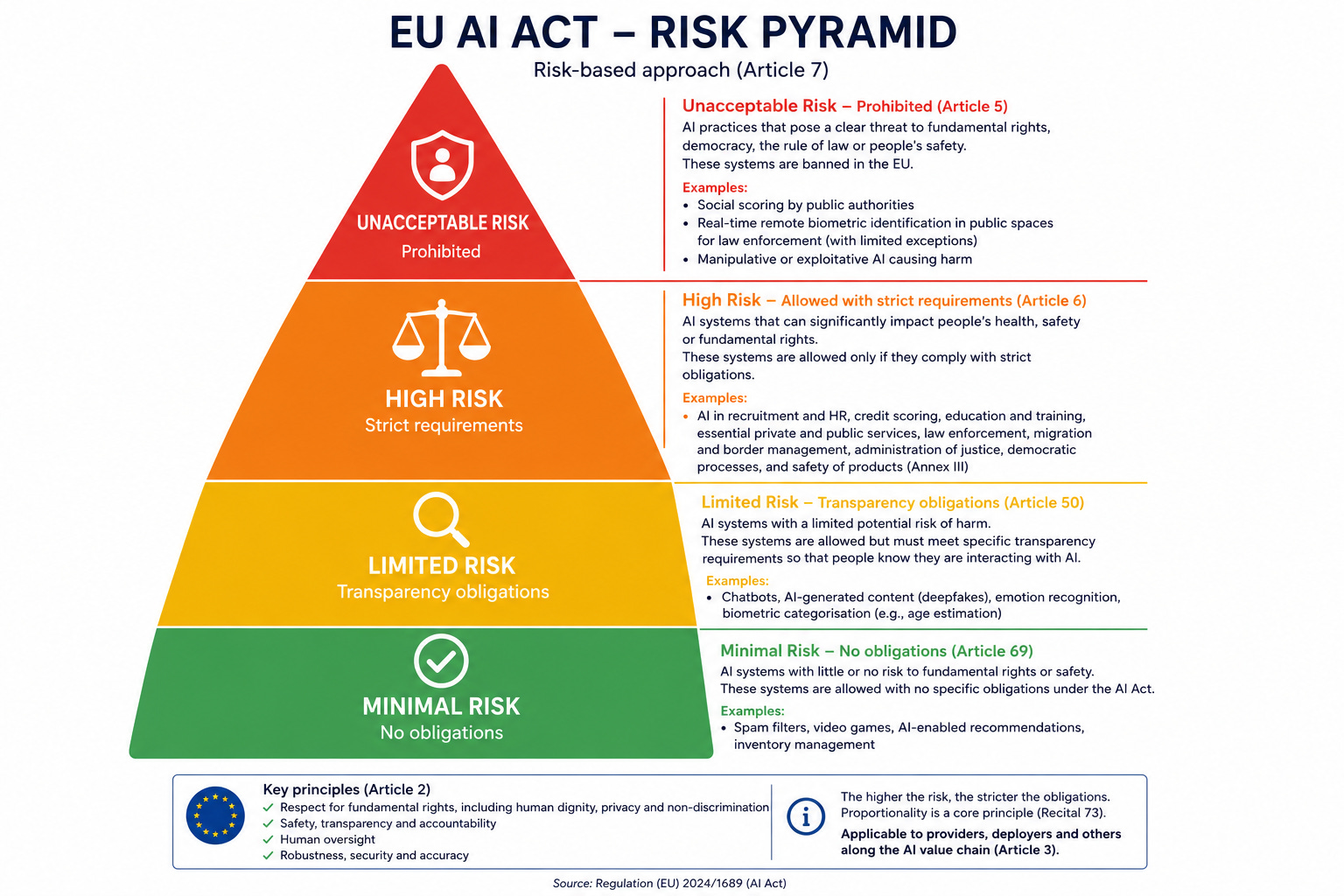
Upon first glance, most would likely agree with the broader risk stratification the EU has codified. The risk rises along with the potential impact on an individual and societal basis. “Unacceptable risk” sits at the top of pyramid, which corresponds to AI potentially posing perils to fundamental rights, democracy or safety. The Act outlines a few use cases of AI use with unacceptable risk, such as deployment of real-time remote biometric identification in public spaces. Based on the examples in the Act, it seems to have been well-intentioned at the outset.
Criminalization of of AI applications that threaten fundamental rights can be a positive development that protects us all from the worst indeed. It can, however, also have nefarious consequences by itself. Which way it goes, all depends on what “fundamental rights” are. That is exactly where the present direction of European institutions does not bode well. The European Court of Human Rights (ECHR) recently convicted Switzerland for not doing enough to avert a “climate emergency.” Apparently, it is a “fundamental human right” to have a government that “protects” its citizens from “harms” of an emergency that cannot be illustrated to exist, but it is not a right to express scientifically sound criticism to such measures. Likewise, since the European Commission introduced its “Union of Equality” LGB-and-alphabet-soup strategy, the European Union seems headed in the direction that mentally troubled children will have the “fundamental right” to be talked into thinking that they are the opposite gender and believing that all their mental issues will disappear as soon as they take devastating, irreversible puberty blockers, cross-sex hormones, or get their genitals lobotomized off. However, any relative, teacher, friend, or pastor who attempts to convince the same children of the immutable and universal truth that they had always been born in the right body, infringes upon those childrens’ “fundamental human right” of “gender identity” by committing “conversion therapy.” Sure.
A realistic outcome of the EU AI act may well be that it will soon be illegal to deploy AI in the European Union that reflects objectively upon a whole set of contested topics, such as climate, medicine, vaccination, gender ideology, religion, immigration, anti-racism and more. While originating from the EU, that development may already be under way in other places too. Colorado’s AI Act was legally challenged by Elon Musk’s xAI for violating the First Amendment and providing unclear standards that are almost impossible to enforce in practice. More specifically, Colorado’s AI Act would prohibit deployment of AI that performs “algorithmic discrimination,” which could, for instance, deny credit or housing applications based on race. All good so far, except for the fact that the Colorado AI Act exempts providers from countering algorithmic discrimination if doing so “increases diversity or redresses historical discrimination:”
(b) “Algorithmic discrimination” does not include: (I) The offer, license, or use of a high-risk artificial intelligence system by a developer or deployer for the sole purpose of: (A) The developer’s or deployer’s self-testing to identify, mitigate, or prevent discrimination or otherwise ensure compliance with state and federal law; or (B) Expanding an applicant, customer, or participant pool to increase diversity or redress historical discrimination; or […]
Colorado AI Act, April 2026 draft status. Presently under revision.
In other words, the Colorado AI act criminalizes discrimination by AI, except in those cases where it discriminates against those not historically discriminated against. Which case is which is up for debate on a case-by-case basis and therefore, impossible for AI companies to enforce without the constant fear of being sued. Following the lawsuit by xAI, which the federal Department of Justice has joined into, Colorado has pushed the implementation of the Bill out and is now revising it.
Any of the proposed AI regulations seem to be thinly veiled attempts to create an AI ecosystem dominated by only a few behemoths allied with the government, at the expense of small and midsize enterprises. Which companies have the capability to constantly monitor ID and track compliance for every post? Moreover, those same companies tend to be the ones that are already producing ideologically skewed AI systems that do things like drawing Hitler as a black woman. AI has the potential to put information, news and science at everybody’s fingertips with close to objectivity, but it must be allowed to do so. We therefore must foster an ecosystem of innovative small companies, that cannot be burdened by endless legal requirements.
A common trend can be observed when attempts are being made to introduce overregulation: the latter always takes place to “protect” an underrepresented group, most frequently children. That is not to say that children would not be able to experience harms from AI. There are examples of the latter. However, in most of those cases, media are all too keen on amplifying the impact of AI, while ignoring the true root cause. A good such example can, regrettably, be found in the Tumbler Ridge school shooting earlier this year. On February 10, 2026, Jesse Van Rootselaar killed two family members before heading to Tumbler Ridge High School, where Jesse went on a wild shooting spree, killing six and injuring twenty-seven other students. All of this happened in the remote mining town of Tumbler Ridge, BC.

Canada already has very strict regulations on firearms, so calls for gun restrictions were not as loud as they would typically be in the US. However, the real culprit was soon identified: Open AI’s ChatGPT, with whom Jesse chatted at length on the devious plans before executing them. Whistleblowers have come forward, stating that the incident was “flagged” at the time, yet Open AI’s leaderdship overruled employees on the safety team. They decided not to notify the Royal Canadian Mounted Police and to just move on after closing the corresponding account. The victims’ parents are rightfully suing for negligence and aiding and abetting of crimes.
Only future will tell if courts hold Open AI liable for assisting in mass violence. However, while the media are all too eager to amplify AI’s role in this tragedy, they seem not as committed to investigate what may well be the deeper root cause of Van Rootselaar’s aggression: toxic transgenderism. Van Rootselaar was a “trans-identifying” male. He had a militant mother who seemed all too happy to have a “trans child.” Since Van Rootselaar set off on his killing spree by executing his mother first, one may infer that he may no longer have been too comfortable with his “true identity.” In fact, Van Rootselaar may well be one of many mentally troubled kids who could have fared well if they had received proper psychological counseling, but instead got the one-stop-shop ticket out of all mental problems, which is to “become trans.” When those children then discover that in fact, becoming “trans” was not the solution to all their problems, yet all the while they have been sterilized and permanently maimed on top of that, well, no wonder that some of them become aggressive. In this case, we don’t know what Van Rootselaar discussed with ChatGPT, but if the chats ever become public domain, it will be highly interesting to learn if ChatGPT also supported his “transition.”
AI should share the immutable and universal truth that everybody is always born in the right body. However, many of present day “woke” AI systems will do just the opposite and they are supported by local governments to do so. It is an open question if Van Rootselaar would have come out as a perfectly normal kid if he had not been exposed to appalling “SOGI” content at school from the earliest age on, had had parents that affirm his sex rather than delusion, and had not been bombarded with a tsunami of pride and “allyship” parades. However, these are the times we live in.
(If AI still allows you to read Wild Horse Wisdom, please consider to subscribe. There is a free tier.)
British Columbia should reflect on the course of events. A good learning would be to review if SOGI content is really appropriate anywhere in education. Unfortunately, the failing Canadian education system is rife with such nonsense and calling for change does not come without peril. Former School Board Trustee Barry Neufeld of Chilliwack, BC, did exactly that. He argued that SOGI has no place in education. He made a few polite comments online, which would fit perfectly into this post, yet he was convicted by the British Columbia “Human Rights” Tribunal to a fine of CAD 750,000 for “human rights violations,” such as “existential denial of the trans identity.” In British Columbia too, it is apparently a “human right” to demand of others to comply with one’s delusion, but freedom of speech or freedom of religion are no longer human rights. We may soon have AI that asks children as a first question “Ever thought that you could be trans?”
In spite of this dire situation, change will eventually come. Also in BC. Van Rootselaar was not the first trans shooter. Unfortunately, we can meanwhile also already say: not the last, either. Recent history is rife with mass shootings committed by “trans identifying” criminals. A concise sample of trans-identifying shooters: Covenant School Shooting, Nashville (2023, 6 deaths), Denver Night Club Shooting (2025, 3 deaths), Minneapolis Annunciation Church Shooting (2025, 2 children murdered, twenty-eight injured), Rhode Island Ice Rink shooting (2026, five deaths). The perpetrators of all of these tragedies differ in the details: “trans kid,” “trans adult,” “trans dad,” etc., but the common denominator of five letters clearly seems to be: “trans.” This list of recent shootings isn’t even exhaustive. If this trend continues, the outcry will soon enough be impossible for authorities to ignore.
We need to urgently address this issue at a societal level. Some other regions are well ahead of the Americas to recognize this and act upon it. However, Brazil just elected a man who pretends to be a woman as head of the Woman’s Rights Commission. In North America too, it is still way too common to run into children put on cross-sex hormones, or into perfectly normally looking girls that wear a name badge on which their name is printed in illegibly small font, but underneath their name, in large print, it reads “They/She.” It is time to stop making any sort of accommodations for this kind of lunacy. It is dangerous in many ways. Even the pronouns are. Assume the “they/she” person gets assaulted and a woke bystander reports the incident to 911: “They are lying on the sidewalk when they attacked she and ran off. They are injured because they gave she many punches.” How shall the emergency call be responded to? Is there one or more perpetrators? Is there one or more victims? How many ambulances need to be dispatched? Is anyone able to respond timely and correctly to such mumbo-jumbo in an emergency situation? The only way to use pronouns without dysfunction is by having them refer to biological sex and natural number. It is not a “human right,” nor reasonably expected decency, to demand to be referred to in the plural as a subject and in the singular subject form as an object.

Media also have a role to play. Media need to urgently end the recent set of unrealistic shows that are depicting boys and young men as the devil. There is no evidence that men who support boys to become men generate mass stabbers, as for instance the entirely imaginary show Adolescence claims. However, the growing list of massacres proves that toxic transgenderism in fact does lead to mass violence. Maybe Netflix should consider producing a show titled “Transdolescents: one step away from a mass tragedy,” which would be much more realistic than its nonsensical Adolescence show.
As a society, we do need to think of the role of AI. It is most likely appropriate to require specific behaviour when AI is consulted by children. But let’s not forget that parents and guardians have a role to play to keep children away from harmful or lewd content. We don’t need to require blanket digital ID to ascertain that. Before we move to further restrictions in the digital space, let’s make sure that the physical space is safe too, for instance by removing SOGI filth from school curricula and libraries, or by keeping children aloof of toxic transgenderism. Age restrictions are highly appropriate for puberty blockers, cross-sex hormones and gender reassignment surgeries. A very reasonable minimum age for those is: one hundred and seventy-five years. All of this applies globally, including British Columbia. The only way out of deranged speech control is by calling it out. “Human rights tribunals” will stop short from suing half of the population if enough people express themselves. They may even cease to exist. It is everyone’s civic duty to stop children from being sterilized and mutilated for life, no matter the consequences.

Soon enough, around here too, local police got weary of the endless identity checks for children in the back seat. When they shared their concern with politicians, the blanket ID checks were abolished. A drive into town again takes no longer than thirty minutes and Bob has time to fire the smoker up himself.
Parents need to step up and stop these unconstitutional laws. This is not about safety for children. Those are just magic words they conjure up to destroy our God given rights guaranteed by our founding documents. People must take action now to stop the data centers and any more surveillance.
A healthy, respected, happy child will not gravitate toward dark areas on the web. The state is raising the children, and teaching them unhealthy things. Parents should, if they have not already, get them out of public indoctrination centers and raise them themselves thru self directed learning and unschooling.
This is what happens when the masters of our republic; the people, allow their servants to be in control. We must take back our power now, before it is too late.
Mandatory affirmation of delusion leads to a dysfunctional society. Tumbler Ridge and all of BC for that matter had a lot of time to curtail toxic transgenderism before it could claim yet another set of victims there. Yet what they did is similar to what happened in Wales in this reference, and we now know the result. Parents need all the support, including legal and legislative, to keep their children as far away from toxic transgenderism as they can.
https://www.dailymail.com/news/article-15901057/Police-hate-incident-mother-trans-child-name.html