

We’ve been experiencing a warm and dry summer up here. Last week, we were hoping for relief. Some modest showers were in the forecast. Nonetheless, our hopes turned to be out idle. To be fair, it did rain a lot in the neighboring county. By the time the clouds were here, they seemed to have lost their appetite, though. Bad luck, we thought. Until we met rancher Clay from G Bar H, that is. Here is what he said:
“We were riding our horses to the high meadows on Mount Clear Sky last Saturday and we hiked up to the summit. We went there pretty early in the morning, for we had heard the forecast. We saw the rain clouds gather over near Mount Brambles. Then two small planes appeared. You could see it started raining cats and dogs over there. Nothing came our way.”

In the beginning, we didn’t know if we could believe Clay. It sounded like we might need a tinfoil hat to talk with him. But then he is a down to earth guy. He doesn’t have the character to make stuff like that up. So we did some internet research and we soon enough found out that it isn’t that far fetched at all.
Many still talk about weather modification techniques as if they are all either a “conspiracy theory,” or science fiction. Nothing is less true, though. The technique to make clouds precipitate faster than they naturally would by spraying certain chemicals into them, is called cloud seeding. In its most common form, small planes are used to spray silver iodide into clouds, which then causes them to precipitously precipitate. Cloud seeding was discovered in 1946 by a research associate who worked with Irving Langmuir (the 1932 laureate of the Nobel Prize for Chemistry). While little known in the general public, it has found pretty broad adoption since. For instance, China deployed it during the 2008 Winter Olympics, both to ascertain snow in the mountains and to keep the weather dry for the opening ceremony in Beijing. In the United States, several of the generally dry Western States work with contractor companies, such as Rainmaker, to generate precipitation in alignment with state or county objectives.
Having existed for about eighty years, the effects of cloud seeding are well-known. Some critiques of it exist. For instance, opponents say that it reduces dew necessary for plants and insects by emptying clouds too rashly. Further criticism mainly consists of the fact that cloud seeding may deprive downstream terrain from precipitation needed there as well. However, peer-reviewed science on this topic suggests otherwise: since some of the crystals the clouds are seeded with carry over as well, an almost uniform 5-15% increase in precipitation downstream has been reported. Silver iodide is potentially toxic to aquatic organisms, such as phytoplankton, but generally no amounts detectable above baseline are found after seeding. From all of these findings, one may conclude that cloud seeding can indeed be beneficial by providing precipitation approximately when and where needed, as long as it is deployed with oversight and its effects are monitored.

Cloud seeding is meanwhile fairly well understood. The relative success of cloud seeding programmes has spurred new ideas. If weather modification is really that effective and almost harmless, we should be exploring more avenues, shouldn’t we? Such argumentation seems to have gained traction over the last few years, most of all so in the climate alarmist community. The reasoning goes as follows: since (some) climate models predict an uncontrollable climate runoff if global temperatures stay at present levels, we must take action to return temperatures to pre-industrial levels. Although climate models are complex, one impactful factor in those models is how much solar radiation the atmosphere is able to reflect back (also called the earth’s albedo). Climate alarmists’ shoebox logic therefore ends up with the conclusion that we need to increase the earth’s albedo if we want to avoid a catastrophe. The way to accomplish that, is by actively spraying substances into the atmosphere to make it more reflective. In their world, reasoning more complex than this simpleton abacus is not necessary: we don’t have the time and the alternative is global annihilation by a runaway climate anyway.
Several approaches have been proposed to increase planetary albedo. While they differ in the details, all come down to spraying some sort of chemicals into a given section of the atmosphere. This group of approaches is most commonly referred to as “solar reflectance management,” or SRM. They roughly subdivide into three categories: stratospheric aerosol injection (SAI), marine cloud brightening (MCB) and cirrus cloud thinning (CCT).
Marine cloud brightening consists of spraying sodium chloride (i.e. sea salt) particles into marine boundary clouds, which makes them brighter, thereby increasing their reflectivity. Cirrus cloud thinning involves spraying high cirrus clouds with ice-nucleating particles, akin to regular cloud seeding, to allow more long wavelength radiation to escape.
Stratospheric aerosol injection (SAI) is inspired by volcanic eruptions. It has widely been observed that volcanoes eject aerosols that can stay in the atmosphere for a few years. Those aerosols consist of suspended micro-scale particular matter, as well as compounds associated with volcanic activity, such as sulphur dioxide. The presence of such aerosols can have a global cooling effect. Mount Pinatubo’s 1991 eruption was estimated to approximately have had a 0.5 degree centigrade global cooling effect that lasted for two years. The idea behind SAI is therefore simple: mimic a volcanic eruption, such as Mount Pinatubo’s, by injecting aerosols of sulphur dioxide, particulate matter — or both — and global temperatures will cool down.
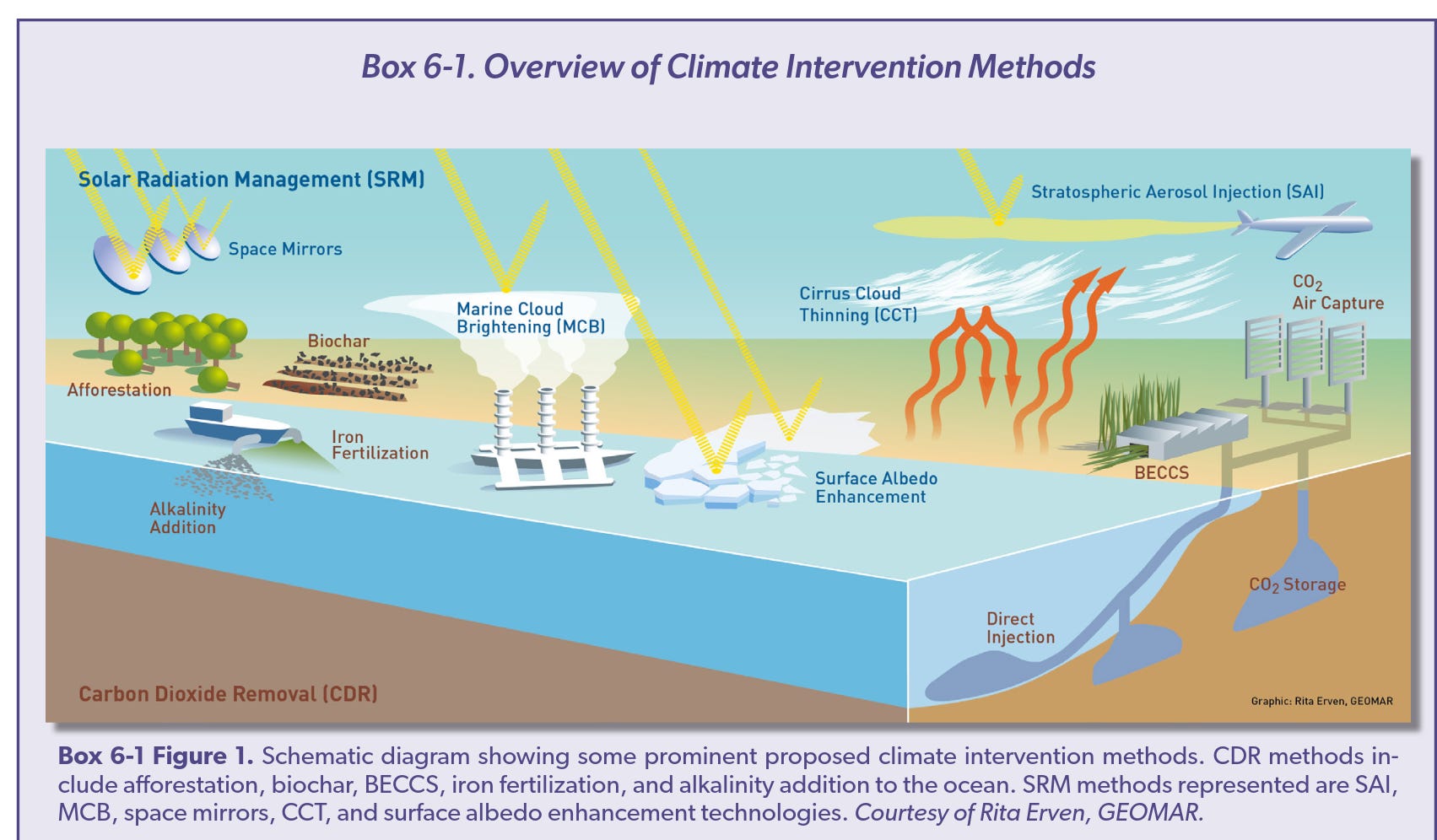
If global cooling is the only outcome to be considered, the math is simple. However, is global cooling really the only effect SAI would have? Could it also have unpredictable effects on climate systems? Or ecosystems? Could it maybe be detrimental to crop yields? How about an impact on public health? Have we looked at any of these? A review article by Zarnetske et al. (2021) summarizes the answer with respect to ecosystems:
“While climate science research has focused on the predicted climate effects of SRM, almost no studies have investigated the impacts that SRM would have on ecological systems.”
Zarnetske et al., PNAS, 118 (2021), e1921854118
Five years later, this statement is still pretty much actual. Some potential detrimental impacts sulphur dioxide based SAI injection may have on ecosystems, are listed in that paper. They encompass:
regional precipitation reductions or redistribution (monsoon weakening, droughts in some areas);
sulfate deposition contributing to acidification;
possible surface-ozone changes;
incomplete reversal of greenhouse-gas effects (ocean acidification continues);
altered primary production and carbon cycling and
high risk from abrupt termination (“termination shock”) producing rapid climate velocities that many species cannot track (they note that high-latitude and southern ecosystems may experience particularly robust changes).
The paper urged five years ago: “It is essential that the knowledge gaps posed above be addressed now.” Yet not that much seems to have happened. Moreover, the perhaps biggest risk associated with sulphur dioxide injection consists in damage to ozone concentrations in the atmosphere. This has an effect on ecosystems and humans alike. In fact, one paper projects what would happen if we started large scale SAI with sulphur dioxode:
“Within the first 10 years of the injection, we find an abrupt deepening of the Antarctic ozone hole by 8%–20% and changes up to 5% for other regions and seasons”
Tilmes et al., Geophysical Research Letters, 48 (2021), e2021GL094058.
The magnitude of the effect should not surprise, given that scenarios considered in an authoritative NOAA report on this issue inject up to 50 Tg SO2 per year — fifty million tonnes per year. What could possibly go wrong?
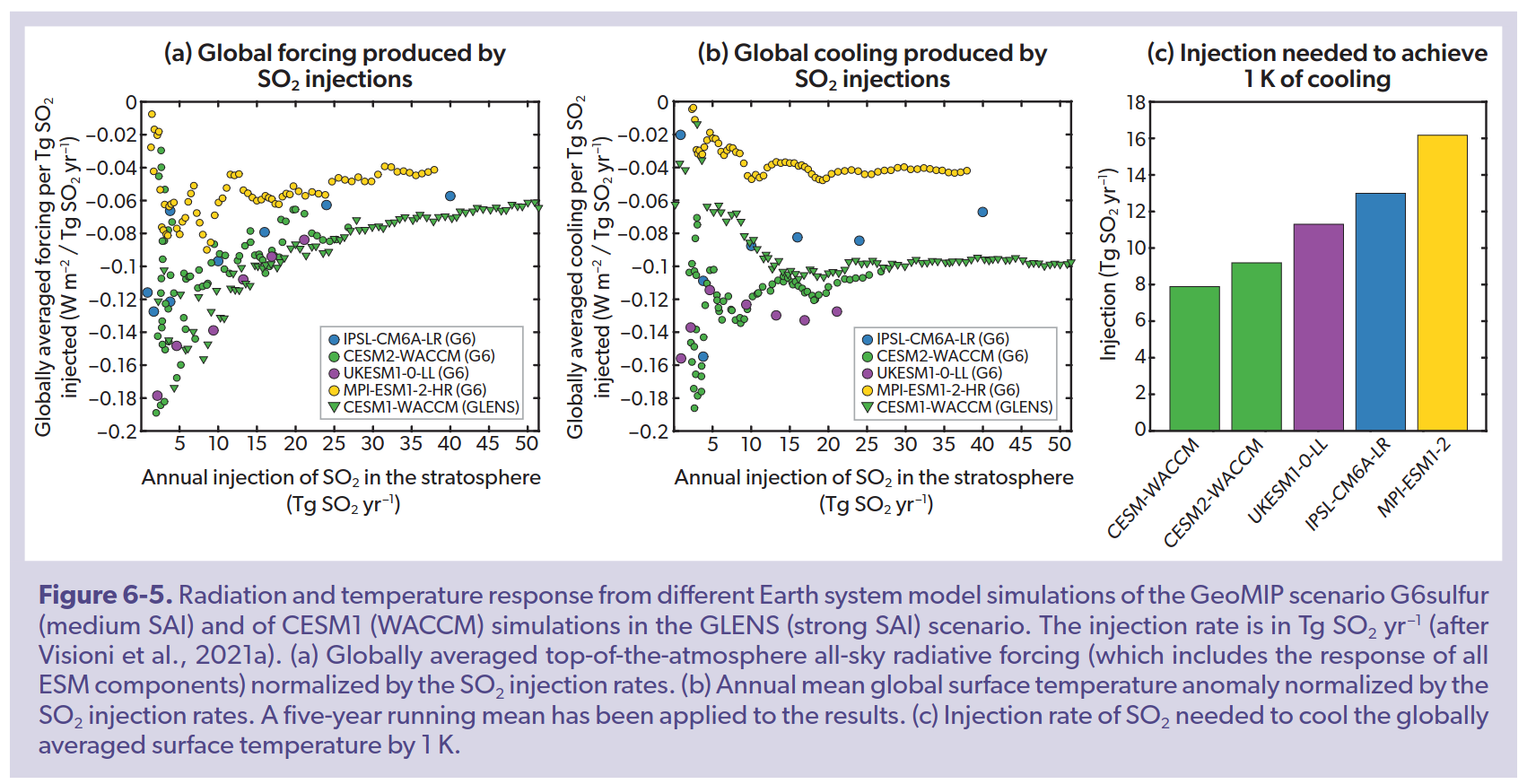
Ozone layer damage is specific to the chemistry resulting from SAI based on sulphur dioxide. This has led some to propose alternatives that avoid sulphur. The most prominent solution in that realm comes from Israeli research company Stardust, which aims to have 10 million tonnes of their product sprayed by governments by 2030. That should only come at a ten billion dollar expense footed by global taxpayers, a bargain, considered it is to avoid a global climate catastrophe.
Stardust’s solution resorts under the broader category of SAI, but instead of sulphur dioxide, their product consists of microscopic amorphous silica particles, in some cases combined with a coating or a calcium carbonate kernel. For sure, those particles do not engage in sulphur chemistry. However, their deployment is not free of risk either.
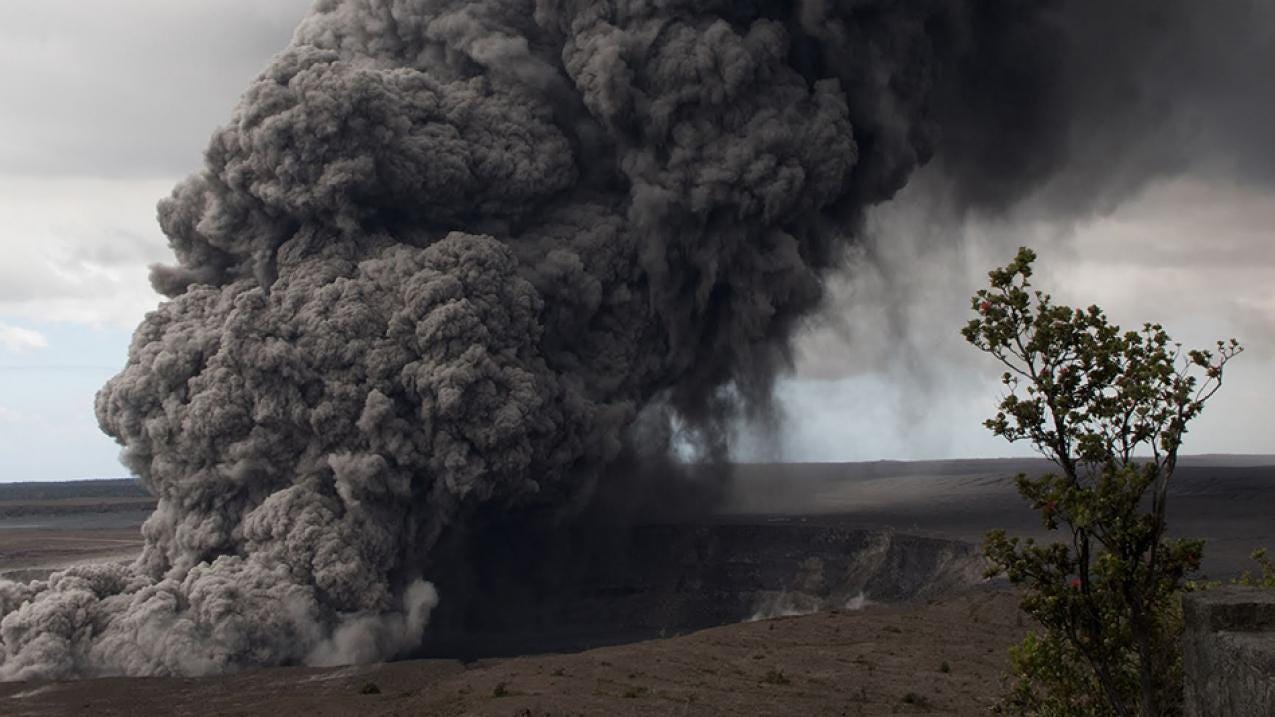
The entire field of SAI lacks much observable evidence, so it resorts to lab scale trials and modelling. Most of the material publicly available actually comes from Stardust itself, e.g. Spector et al. (2026), which extensively describes experiments and simulations. However, we do have some real world evidence of what SAI could lead to. In fact, the best observations are those that are also used to advocate for SAI: the effects of volcanic eruptions themselves. Those are not all rosy either. Apart from the reported global cooling effect, volcanic eruptions have been associated with failed crops and rampant spread of disease. In fact, the year 1815 was known as the “year without a summer,” a title not worth vying for, owed to the eruption of Mount Tambora. Summertime snow, widespread crop failures, famine and flu-like epidemics were reported.
It does not take much common sense to understand these effects. Every farmer knows that crops grow better in the summer than in the winter and we wouldn’t call a cold a “cold” if it were more common during a heat wave. Much of that statement can be traced back to lack of UV (and particularly UV-B) irradiation on dark winter days. The common saying “sunlight is the best disinfectant” is pretty true and is supported by scientific evidence. It is mainly owed to UV-B, which acts as a germicide. Moreover, our own bodies use UV-B energy to synthesize vitamin D, a component vital to our immune systems. If SAI were deployed, our exposure specifically to UV radiation would be drastically reduced. In fact, some of the best scientific estimates we have, put it at a twenty percent reduction. What could possibly go wrong, given that most citizens in North America are already vitamin D deficient?
The entire movement for SRM comes off as a rushed response to a problem that was never a problem to begin with. If adopted, SRM would to accomplish a one to two degrees centigrade global cooling, to avoid a “climate catastrophe” that only occurs in models. It may have pernicious side effects, the extent of which is very poorly understood.
It is hard not to see the parallels between the hubris of SRM supporters and supporters of the pseudo-religion of scientism in other domains. Trust “The Science.” Sure, except that “the science” seems to be increasingly irreproducible and disconnected from observations. It has become oversimplified and has developed an insidious tendency to view model outputs, rather than observable quantities, as authoritative reality.
When certain epidemiologists forecast millions of COVID deaths based on models that failed to predict the present, the action absolutely necessary to avoid that fictitious outcome was to fixate on one number predicted by those models (the number of cases) and lower it by reducing the one factor most likely to lead to the desired outcome (the reproduction number) — according to the model, that is. Masking and social distancing presented themselves as the straightforward way to impact the reproduction number in practice. Just do those two, and the pandemic will die out. Of course, the real course of events turned out to be just a little different from the oversimplification.
In the case of SRM too, believers use climate models that fail to accurately predict the present to argue for urgent intervention to avoid a catastrophe that only exists in the outputs of those same models. They do so by fixating on one number that summarizes planetary climate (global average temperature) and by trying to modify the one factor most impactful to reduce that number (planetary albedo), at least in the models, that is. Spraying reflective chemicals into the atmosphere presents itself as the straightforward way to impact albedo in practice. Just do that, temperatures will decrease and all else will be fine. Or will it? Could it be that climate and weather systems turn out to be just a little more complex than what the models can predict?
It is time to let go of a combination of over-reliance on modeling and simpleton logic with potential devastating effects on a global scale. We must return to reproducible science in which models are subordinate to actual observations. Honest science must also acknowledge what we do not yet know.
Given that SRM provides the sole benefit of artificially cooling the planet by one or two degrees, while having potentially immense, uncontrollable side effects on local climate, the ozone layer, ecosystems and even public health, a global moratorium on any SRM activity is the right way forward. Further research should also be carried out, in a way that is limited, yet representative in scope and that does not over-rely on inaccurate models.
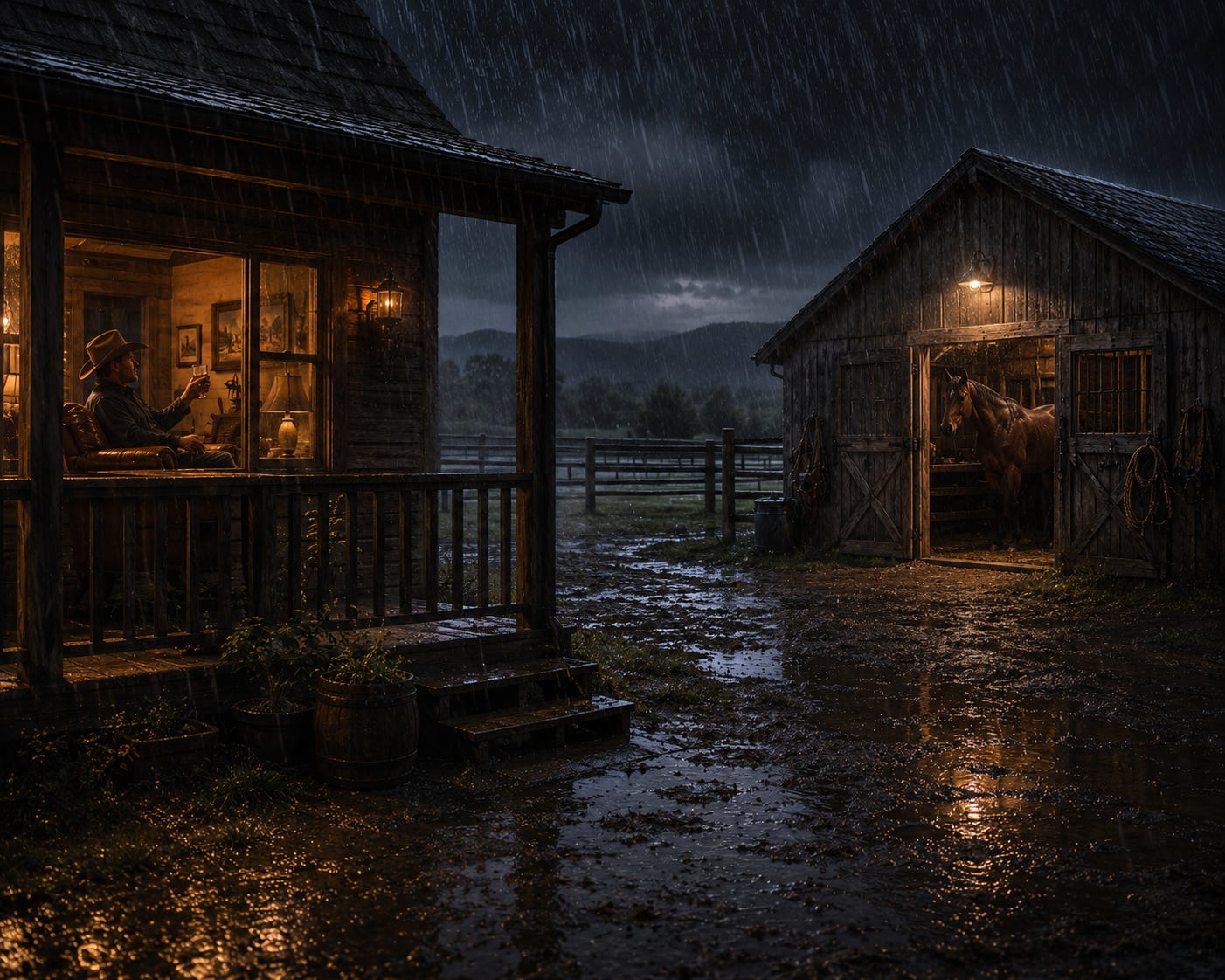
As long as we’re limiting ourselves to cloud seeding, the fallout can be managed. It turned out that our county has some agreements with the neighbours. Not more than a week later we got the rain we’d been waiting for. Rain makes corn and corn makes whisky, which we had to enjoy inside for once while it was pouring down out there.
If you like this article, please help us stimulate Substack’s algorithm and click the ♡ button
Very insightful, thank you!
I believe it was in the 1970’s that power plants were required to install electrostatic precipitators to reduce/eliminate particulate matter emissions from smokestacks. This particulate matter served a purpose of reflecting the sun’s rays.
In the 1980’s and 1990’s flue gas desulfization (scrubbers) were required to reduce sulfur dioxide emissions.
Who knew that these costly technological fixes actually had some negative consequences?