

Cowgirl Melanie was sent out on an errand yesterday. She should have replenished the Ranch house’s stack of coffee, but she returned empty-handed. When she was asked why she didn’t bring the coffee, she said she had been turned down because since this week, only people born before April 25, 2002, are allowed to buy it. Sure, enough, we soon sent cowgirl Jackie with her, who just turned 24. Yet we were still all shocked. “What’s the next thing we won’t be allowed to buy?” was Melanie’s rhetorical question, cried out in despair. From my side, I hope it isn’t hay …

It may sound pretty ridiculous that one has to be twenty-four or older to buy coffee. But whether it should, is a better question. Just earlier this week, the United Kingdom’s Labour government announced that the minimum required age to buy tobacco products would gradually increase, until eventually nobody will be old enough to buy them in a few decades from now. More specifically, starting in 2027, one will have to be born before January 1, 2009, to be legally allowed to buy tobacco products. That is a stipulation in the Tobacco and Vapes Bill, which passed the Houses of Parliament and is presently awaiting Royal Ascent. The latter is typically a formality, so those presently seventeen years old or younger will never be able to buy tobacco, or vapes, in the UK.
The Bill’s proponents rejoice in praise. In their view, the Bill finally protects future generations from consuming products that have long proven to be harmful to health. It is an open question, though, whether this bill sets a defensible, or a dystopian precedent. Verily, from next year forward, eighteen-year-olds will no longer be able to buy tobacco. At least legally, that is. Consumption of recreational marijuana is illicit in the United Kingdom too. Nonetheless, its use is widespread, notably also among teenagers. Back in 2018, a report from the Institute of Economic Affairs estimated the UK’s cannabis market at a staggering £2.5 billion a year. Adjusting for inflation, that should be at five billion by now, if not more. Those five billion constitute a black market for an illicit product that is nonetheless mass-consumed. Due to the criminal nature of the market, it lacks any reliable quality control. Marijuana users therefore often end up unwittingly consuming dangerous contaminants.
Marijuana is not only smoked because it tastes well, or because it is relaxing. Black markets attract many because their products are illicit. In the United States, the legal drinking age is 21. Just for that reason, many college freshmen will think it is very cool to already have a beer. By the time they are twenty-five, they may still or may no longer drink, but if they do, they will no longer be motivated by doing something illegal and may therefore enjoy the drinks in a more relaxed way. Marijuana and tobacco are often consumed together. Adding those two things up leads one to surmise that soon, the UK will both have a £5 billion marijuana and a £5 billion tobacco black market, thereby opening the floodgates to the criminal economy.
The UK’s Tobacco and Vapes Bill may not achieve the goals its proponents have advertised. From that perspective alone, one wonders if it wouldn’t have been better for the government to do nothing more than spread information about the dangers of tobacco use. However, the bill sets a very dangerous precedent. The Bill outlaws a product for its known health hazard, more specifically the existence of a causal link to cancer, as established by the health authorities. That may be reasonable, as long as we can trust the expertise in the respective governing bodies. Even if so, another question to be raised is at which point a product is thought sufficiently noxious to justify a ban. Objective criteria would be welcome.
As long as we are discussing tobacco, most will believe the evidence for the strong link between its consumption and lung cancer. Over four decades of scientific results attest to it. However, even that causal relationship can be abused by authorities when they start drawing unsubstantiated parallels.
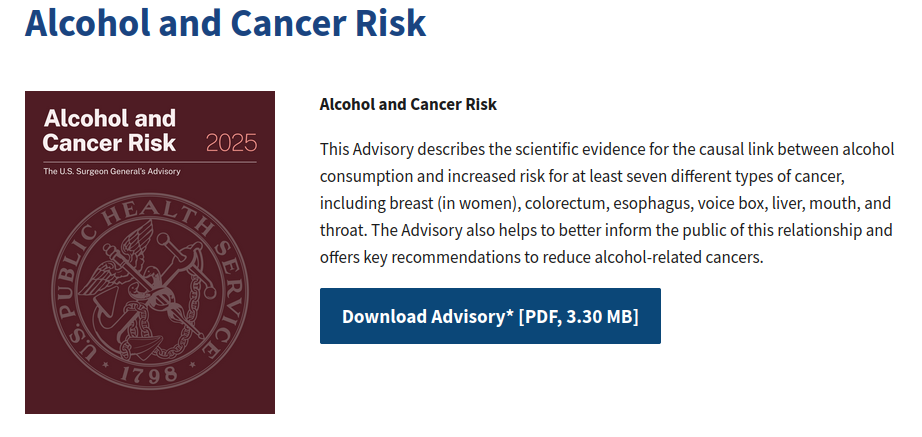
Only a little over a year ago, in one the his last acts, the outgoing US Surgeon General Vivek Murthy issued a report on the “causal link between alcohol consumption and cancer.” Notably, this followed on the heels of a statement by the World Health Organization, who stated that “no amount of alcohol consumption is safe.” The report advocated for the introduction of cancer warnings on alcoholic beverage containers. Moreover, the report would like to see increased awareness of alcohol’s link to cancer in the general public, since its conclusions are based on “the same approach that was used to conclude that smoking causes cancer.”
Except, the latter is not really true. On an abstract level, yes, similar observational studies were used to prove that tobacco causes cancer. Only, in the case of tobacco, the signal was much stronger and accompanied by other forms of evidence. In case of alcohol, much of Vivek Murthy’s report was built upon a handful of papers that try to draw population level inference by relating the number of cancer cases by country to the amount of alcohol consumed per capita. Those papers themselves admit that they are based on many unknowns that are hard to correct for, such as the impact of tourism … or of smoking, for that matter. We analyzed the references in Murthy’s report and could only conclude that the evidence provided in it is very weak. In fact, the comparison to the rigorous nature of the evidence that supports the cancer link for tobacco, should be considered nothing more than propaganda.
Inspired by the methods used in those papers, let’s do a small experiment and extend that exercise to recent data from the United States. Data more recent than those used in the publications cited by Murphy, that is. Below we plot the alcohol consumption (as reported by the National Institute on Alcohol Abuse and Alcoholism, NIAAA) and the overall number of age-adjusted cancer cases (as reported by the National Cancer Institute) per capita in the United States since 2016.
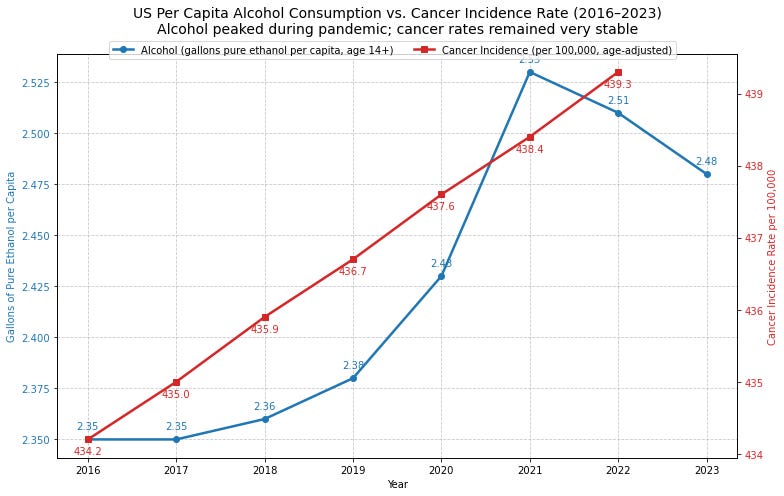
In fact, if we were to adopt the same type of analysis, we might draw very different conclusions, dependent upon the time window considered. Limiting the window to the early 2010s, there seems to be little association between both. Expanding the window to 2020 would likely find a connection between alcohol consumption and cancer. However, since 2021, we observe an interesting phenomenon. Since alcohol consumption per capita peaked in 2021 during the pandemic, it has steadily fallen back. Yet cancer cases have not at all. It will be exciting to analyze official data from 2022-2026, once they become available. If the trend that began in 2021 continues, this type of analysis might soon suggest that alcohol is a cure for cancer. We are in no way saying that it is, but that is what the conclusion would be using the same “strong” evidence Murthy used to prove the opposite.
A year before our publication on Murthy’s report, we also analyzed a technical report that was supposed to underpin the Canadian Centre for Substance Abuse’s revision of “safe drinking limits.” The CCSA revised its “safe limit” from two beers a day to a puny .. two beers a week. We are to believe that they did so based on “new scientific evidence,” which their own “rigorous meta-analysis” had condensed into an actionable guideline. However, we took a deep dive into their technical report, and found that they had set arbitrarily stringent selection criteria to include results from scientific papers. In so doing, results from a mere sixteen out of 5934 identified studies were propagated. Not a single study that concludes a health benefit of moderate alcohol consumption was retained. Yet some of the sixteen papers included quantified behavioral risks, such as the increased risk for accidents (traffic and general). We would argue that those risks can, for instance, be countered more effectively by not driving than by not drinking.
In spite of the CCSA’s model being based on close to hand-picked evidence of alcohol’s risks, it still could not lead one to draw a clear conclusion. In fact, according to the CCSA’s own model, a person who consumes fourteen beers a week is expected to live on average to the age of 81.6, whereas a person who adheres to the revised limit of two beers a week, is expected to live to the age of … 82.1. The difference between the CCSA’s old and revised safe drinking limits does not even amount to half a year of life expectancy. It is an almost negligible reward for giving up one of the things that makes life enjoyable. The mere fact that they did conclude to revise the limit, therefore, seems rather arbitrary. One is drawn to surmise that lowering the “safe drinking limit” was the planned outcome of their study all along. They did everything they could to land that conclusion, yet failed to come up with convincing results.

Many will say that the fact that the CCSA did not include any studies that attest to benefits of moderate drinking, is in line with “recent scientific evidence.” Popular news outlets can be heard referring to the “now debunked notion” that moderate alcohol consumption would have cardiovascular benefits. However, there evidence is more nuanced in that case too. Virtually concomitant with the publication of Murthy’s report (early 2025), the US National Academies of Science, Engineering and Medicine published a thorough meta-analysis on the effect of alcohol on several health outcomes.
We will at first note that that report does conclude an association between alcohol consumption and breast cancer. However, it also makes a few other notable statements. At first, the report concludes that moderate alcohol consumption actually lowers all-cause mortality. From their finding 3-1:
“[…] there was a 16 percent lower risk of all-cause mortality among those who consumed moderate levels of alcohol compared with those who never consumed alcohol (RR = 0.84, 95%CI [0.81, 0.87]).”
National Academies of Sciences, Engineering, and Medicine. 2025. Review of Evidence on Alcohol and Health.
Moreover, if one were inclined to conclude that the finding on breast cancer should lead to a different result for women, that would also be incorrect. Finding 3-2 reads:
“[…] a 23 percent lower risk of all-cause mortality was found among females who consumed moderate amounts of alcohol compared with females who never consumed alcohol (RR = 0.77, 95%CI [0.6, 0.97]).”
National Academies of Sciences, Engineering, and Medicine. 2025. Review of Evidence on Alcohol and Health.
The report further mentions that these updated research findings, that include literature from the 2020s, are in line with previous conclusions in 2015 and 2020.
If alcohol puts females at a higher risk of breast cancer, but still lowers their all cause mortality risk, there must be benefits associated with moderate alcohol consumption, right? Could those be advantages in the cardiovascular sphere? Well, in spite of some calling those “debunked,” the study concluded that persons who drink moderate amounts of alcohol have a 22% lower risk of myocardial infarction and a 12% lower risk of stroke, which is consistent with the estimated 18% lower risk of general cardiovascular disease. Finding 6-3 states:
“an 18 percent lower risk of CVD mortality among persons who consumed moderate amounts of alcohol compared with those who never consumed alcohol (RR = 0.82, 95%CI [0.76, 0.89])”
National Academies of Sciences, Engineering, and Medicine. 2025. Review of Evidence on Alcohol and Health.
So long, dear “debunkers.” In fact, this study underlines what many of us know intuitively: consuming high amounts of alcohol is nefarious, but consuming moderate amounts of alcohol bears a negligible risk.
The National Academies may have published an objective, thorough meta-analysis into moderate alcohol consumption, yet it drew little attention. On the other hand, Vivek Murthy, being the “health authority,” found copious media amplification. Murthy’s report is a clear example of “health authorities” furthering a narrative, while ignoring evidence to the contrary. Exactly because “health authorities” can be observed to base guidance on biased conclusions, it is very dangerous to allow products to be banned, or their use be phased out, based on what “health authorities” recommend. Will the minimum drinking age soon be 65? What is next after that?
Is a minimum age for coffee is still unthinkable from that perspective? If not coffee, meat may definitely be another target. With the existence of recent literature that tries to establish a causal link between consumption of red meat and cancer, there may soon be a minimum age to buy red meat at the butcher’s... In this context too, we analyzed the connection between red meat consumption and cancer and found it to be based on quite ramshackle evidence as well.
An even scarier notion than the Tobacco and Vapes Bill would be a programmable digital currency, which governments could program in such a way that it cannot be used to buy anything that “health authorities” deem dangerous. Exactly for that reason, we must say a collective and heartfelt “no” to any form of “technocracy” by “experts.” The days when “experts” based their conclusions on sound evidence and experience are bygone in many fields. The last few years have illustrated that professions that have both feet in reality, such as farmers and truckers, often have more common sense than many of the self-glorifying “experts.” The case for democracy was never stronger than today.

Soon after the minimum age for coffee had been set, tents appeared all over the place in the prairie. Even I could see some from right here at the stable. Young people from around the area now gathered there around a pot of coffee. The minimum age had made coffee fashionable overnight. Reacting to the “tent epidemic,” the government soon rescinded its new rule. As to us horses, we still have hay too.
It has been proven that if you drink green tea every morning rather than coffee there is a 99% chance you will be miserable ...
These studies are often statistical correlations, not rigorous cause and effect analyses. It's like saying cancer is highly correlated with age, so don't get old!
Everything in moderation ....
It has been only a few days since the UK's phaseout passed the Houses of Parliament and now we have the Canadian health minister proposing the same:
https://www.theepochtimes.com/world/canadian-health-minister-eyes-possible-smoking-ban-in-wake-of-proposed-uk-law-6018816
We shall leave adults the option to make adult choices and steer far away from allowing "health authorities" to make decisions for all of us. Recent times have shown over again that their judgment is not always the best.