

We heard a sad story last week. Six Bars Ranch has closed down. It’s sad to drive past there and see the “land for sale” signs. It was even more spooky, though, to learn why they no longer could manage. I heard it when Bob pulled over onto a rest area half way to the neighboring town. As it turned out, Jake, the rancher at Bar UE, was also taking a break there. He knew the folks from Six Bars pretty well.
“The couldn’t afford the water for their cattle,” said Jake.
“But didn’t they get their water from their own well?” Bob asked in bewilderment.
“They sure did,” Jake replied, “but since this year they gotta pay drawing rights too. Doesn’t matter where their well is. It’s a measure to end the ‘global water bankruptcy,’ they say.”
“Water Bankruptcy?” Bob needed to let that sink in for a bit. “Didn’t know we were water bankrupt. Sure doesn’t look like that to me!”

Bob will not be the only person who doesn’t see a water bankruptcy. Even in dry climates like here, there is ample water to be tapped from creeks, lakes and wells. Yet the United Nations think otherwise. Earlier this year, the United Nations University (UNU) published a call to action entitled Global Water Bankruptcy: Living Beyond Our Hydrological Means in the Post-Crisis Era.
The main thesis in the paper from the United Nations University is straightforward: many hydrological systems on the planet are beyond repair. Therefore, it is no longer sufficient to act in terms of “dealing with water stress” or “handling a water crisis,” but we need to adapt to the new reality instead. A return to normalcy has become simply impossible.
The document draws sundry analogies to finance. In the water economy, creeks, lakes and rivers are compared to “checking accounts,” which are regularly deposited into and from which water can be drawn at any time. Systems like glaciers are “water savings accounts,” which allow the checking accounts to be replenished in times of stress. According to the document, both checking and savings accounts have run dry. The global water situation is therefore not a temporary “cash flow” problem, but a full out “bankruptcy,” which can only be resolved by entering into a fundamentally different era of governance. In the document’s terms:
“Water bankruptcy” is the term to refer to this new reality, not for rhetorical escalation, but for diagnostic clarity. Using it must spark new discourse on a post-crisis state in which human–water systems have overspent their water capital and crossed critical tipping points. These systems must now be governed on fundamentally different terms.
United Nations University, “Global Water Bankruptcy”
To imagine how we could have ended up in a state of water bankruptcy, let’s take the example of underground aquifers, such as the one which Bar UE Ranch’s well draws from. Once aquifers run entirely dry, they may structurally collapse, depending on the weight of the materials above and the type of bedrock they run through. It is well documented that hydrological compaction has caused the creation of numerous sinkholes, for instance in Turkey. Notably, such a compaction is more likely in urbanized areas that also carry the weight of infrastructure on top. Of course, once an aquifer collapses, it can no longer be replenished.
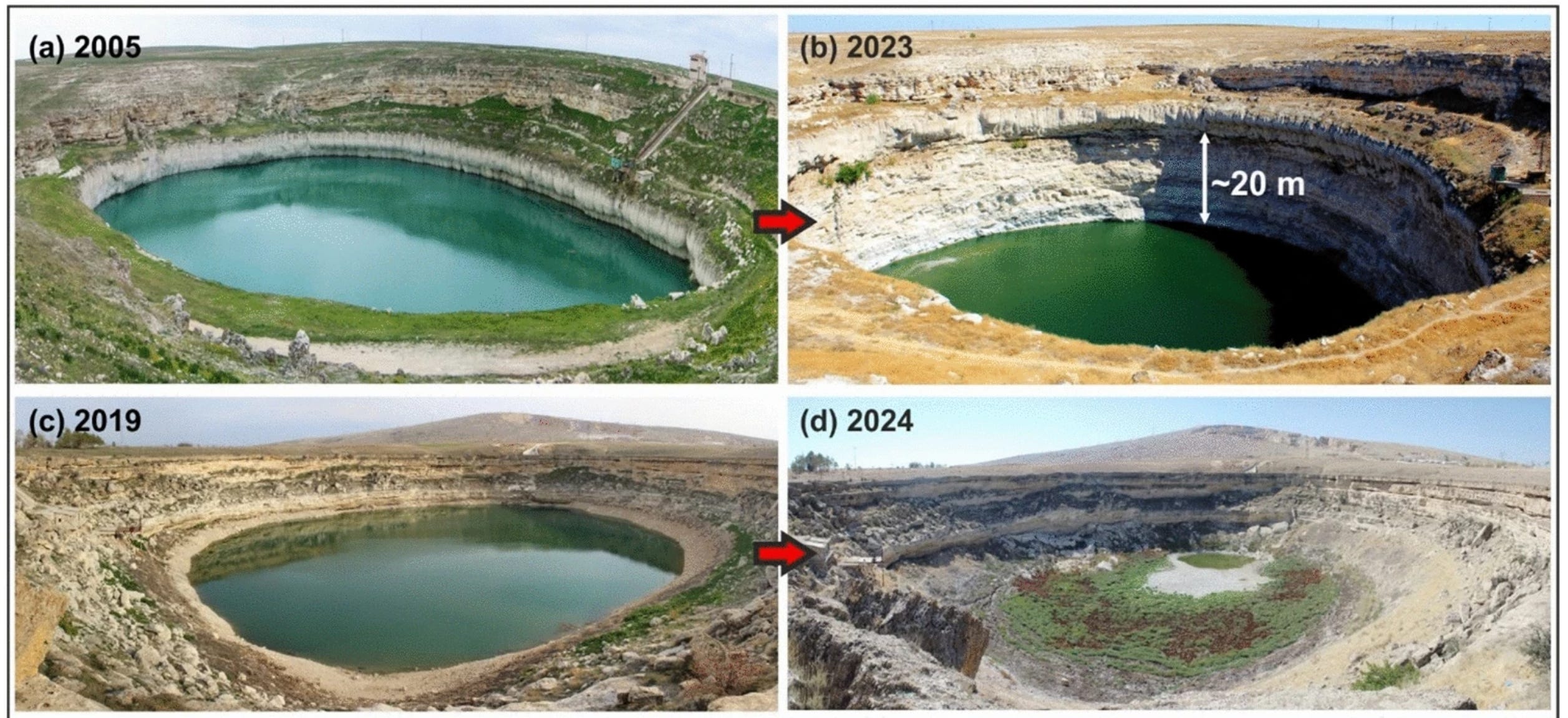
This is one example of why it can make sense to think about groundwater depletion as an irreversible condition. However, as is true for most topics, there are many shades of grey between white and black. It takes a lot for an aquifer to entirely vanish. It should, therefore, not surprise that some literature can be found that reports reversal. A review in Science, notably published more recently than the United Nations report, documents how human intervention has actually led to a successful rise in groundwater levels. The same author has previously analyzed over five hundred aquifers and has reported recovery in sixteen percent of the water systems analyzed. Local examples can also be found. For instance, recovery of groundwater levels was observed in California’s Central Valley after the severe drought in the late-2010s.
These individual success stories need not imply that any concern is unfounded. Sundry groundwater systems are approaching depletion levels. A sixteen percent recovery is not per se a number to be jubilant about, either. It is worth nothing, though, that the most dire situations only exist in distinct regions. For instance, Iran has been hard hit, but there is little reason to claim the existence of “water bankruptcy” in most of North America, so it seems odd to designate the present state of affairs as a “global water bankruptcy.” Yet, in spite of regional differences, there does seem to be a valid reason for concern, which then calls for the creation of an action plan.
(If the free tier of a Wild Horse Wisdom subscription does not make you water bankrupt, please consider to subscribe)
The United Nations will convene its Global Water Conferences later in 2026 and again in 2028. These conferences have been going on since the seventies and have generally attracted lacklustre media attention. If the paper from UNU gets its way, this time will be different, though. It intends to use these upcoming events to establish “a new global water agenda aligned with Anthropocene realities.”
According to the UNU paper, here are the steps needed for “resetting the global water agenda.” At first, we need to acknowledge the existence of the (water) bankruptcy. As soon as we are honest about being bankrupt, we have to proceed by assessing the state of affairs. Data need to be collected on a global basis: for each basin, accounting has to be rolled out to keep track of every gallon of supply and demand of fresh water. Based on the results of that accounting, the water reset can then proceed by “rebalancing of claims and expectations,” which allows us to “deliberately adapt to the new normal.” The UNU document clearly outlines what happens when we start “rebalancing:”
In many human-water systems, the sum of legal rights, informal expectations, and development promises exceeds what the degraded system can supply. This claim–capacity mismatch and expectations-reality gap cannot be closed through marginal efficiency gains or new infrastructure alone. It requires structural reductions and reallocations in demand: revisiting water rights, revising crop mixes and land use patterns, reconsidering the size and location of cities and industries, and adjusting environmental flow commitments to what is ecologically essential and feasible. This rebalancing is politically sensitive, but unavoidable.
United Nations University, “Global Water Bankruptcy”
In brief, the water bankruptcy can lead to a UN led mandate to reassign property rights and rights of land use, as well as the power of local authorities over regional development projects. Of course, neither property owners, real estate developers or local authorities will voluntarily adopt their practices overnight to the “new normal,” so the document calls for big finance to accelerate the change:
Mobilize and align finance for managing water bankruptcy and supporting just transitions.
Encourage the creation and expansion of dedicated global and regional water funds, and a significant increase in the share of existing climate, biodiversity, and land finance explicitly directed to water-related actions that reduce over-extraction, restore degraded water-related ecosystems, strengthen the resilience of vulnerable communities, and integrate water into wider investment and development planning.
United Nations University, Global Water Bankruptcy
To be clear, there is a need to consider more sustainable solutions for the future and the document does advocate for a transition that assigns minimum drawing rights to low-income households and “smallholder farms.” At this point, it is still unclear where the United Nations want to go with this topic. Maybe the 2026 Global Water Conference will bring more transparency.
The Global Water Bankruptcy can still become a catalyst for positive change. The language in the document is reminiscent of some events in the recent past, though. When we see terms like “reset,” “new normal,” “rebalancing rights” and “alignment of finance” all linked together in one document, we can’t help but recollect that we have seen a very similar set of terms a few times before. One place that comes to mind is Klaus Schwab and Thierry Malleret’s COVID-19: The Great Reset, a book in which the then-leadership of the morally defunct World Economic Forum made the case to (ab)use the COVID pandemic to “reset” the global economy into a “stakeholder” model rather than a model driven by profit only. The way to bring “stakeholders” to the table was by having “inclusive finance” that accounted for metrics other than profit, such as DEI and ESG scores.
It has meanwhile become apparent to most that finance driven by ESG scores leads to dysfunction all around, from hostile workplaces to critical defense contractors not being able to get access to credit. Big banks have therefore largely recoiled from their ESG and “decarbonization” efforts, albeit we would still welcome a complete abolition. It is possible, though, that the water bankruptcy is the next excuse to bring in a financing system based on scarcity: with the “reset” being repackaged from COVID into climate and now into water, the water bankruptcy could well be abused to set up markets for “water credits” just like the extant trading systems do for “carbon accounting.”
While it is still too early to say with confidence in which way the water agenda will evolve, one thing is clear: any of the UNU paper’s positions are based on scarcity. Whether they develop into proposals for an assignment based water economy, remains to be seen. However, we can also take the present state of uncertainty as an opportunity: it is still possible to design alternative proposals.
With about 71% of the earth’s surface being covered in water, it seems odd to be running into an agenda based on water scarcity. Water is truly abundant. All we have to do, is to make use of this abundance in combination with deployment of advanced energy. It has been shown that, if humans take appropriate action, deterioration of water resources can be reversed. For instance, large scale recovery of aquifers was reported in (dry) Northern China due to (appropriate) human intervention. Such stories of trend reversal need not be limited to Northern China.
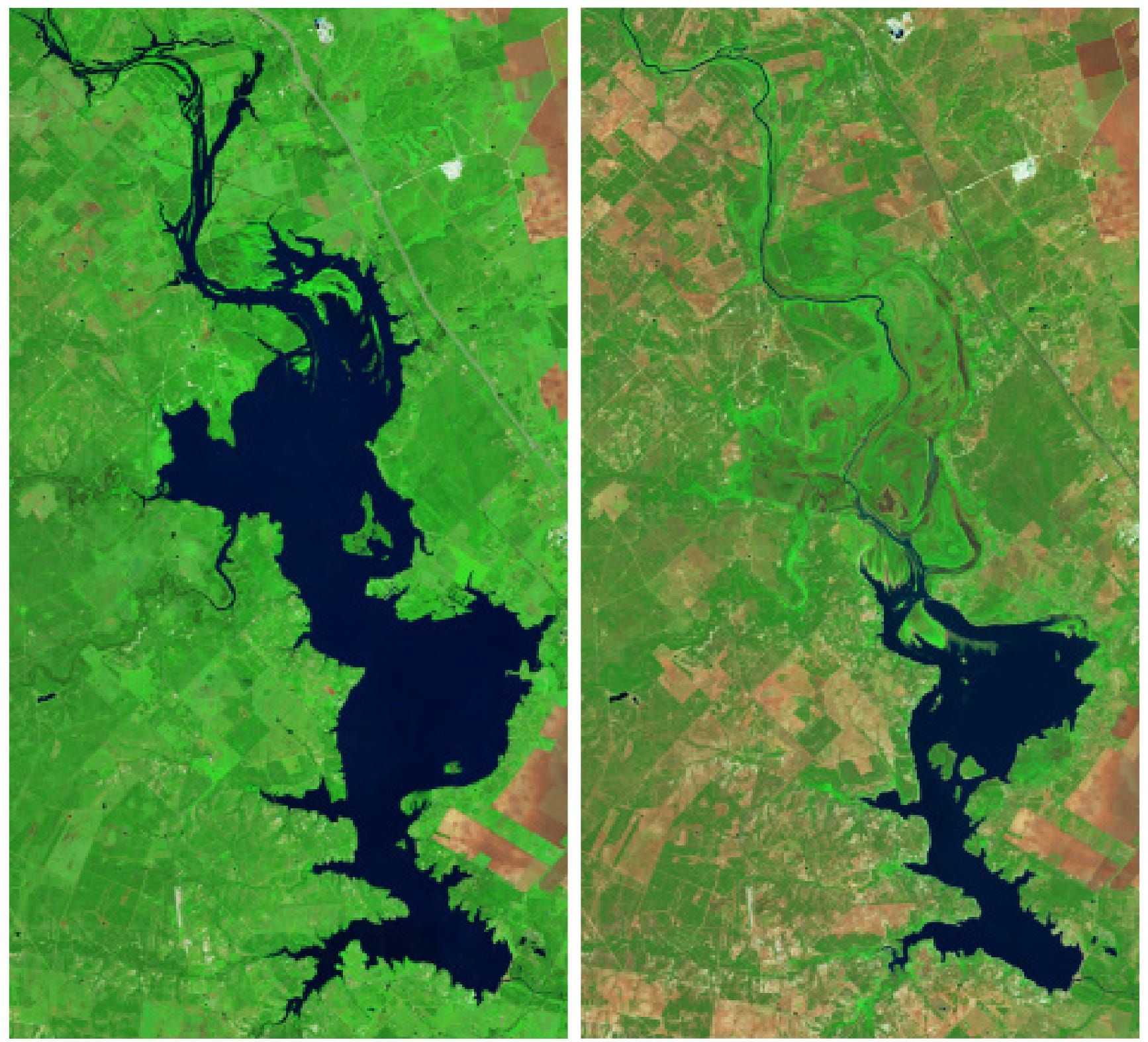
Let’s take southern Texas as an example. The drought in that region, which has been persisting up to certain levels since 2022, is used as an example in the UNU paper. The paper mentions that Lake Corpus Christi has been running at historically low levels, which has had a detrimental impact on the cotton industry in the region. This is silently presented as an example of the need to “adopt new land use patterns.” What is not mentioned, though, is that Corpus Christi is situated right on the Gulf shore (presently, the Gulf of America). The Gulf contains ample water, so all we have to do is to get it into Lake Corpus Christi and its surrounding groundwater aquifers in a usable condition.
The way to proceed is: replenish lakes and aquifers through desalination. Of course, that requires energy, so it can only happen if we also invest massively in abundant, energy-dense power generation, which in today’s world means: nuclear. With abundant nuclear power available to provide freshwater, lake Corpus Christi can readily be restored to its former glory. If we mirror this to meet Southern California’s freshwater needs, we can also eliminate the stress on the Colorado River basin, which would effectively end any state of “water bankruptcy” in the US.
The idea to refill as much as an entire lake through desalination may seem outlandish to some, but it is actually very realistic. Israel is doing just that to replenish its sole large freshwater reserve: the “sea” of Galilee. But Israel does not stand alone. China reported as many as 167 desalination projects in 2025. Even in South Texas, a desalination project is being considered on the southern tip of South Padre Island. Notably, the same island’s northernmost point is … right next to Corpus Christi. Moreover, the concept to use nuclear energy for this purpose is widely acknowledged. The world nuclear association states that nuclear cogeneration of electricity and potable water can dramatically lower water purification costs compared to standalone plants.
Countries that have water-stressed regions need to develop national desalination strategies. As a prerequisite to those, Wild Horse Wisdom’s claims to invest in energy abundance need to be heard. Today, deployment of large-scale nuclear energy is needed. Yet is has to be combined with ambitious investment into research and development of potential next era generation technologies, such as fusion or zero point energy. When those energy sources become available, we will not only have power generation without emissions and a stable power grid, but also … abundant energy that can be used to desalinate Gulf and ocean water as much as is needed to replenish freshwater reserves.
Whenever bad news arrives, we can weep, but we can also see it as an opportunity. That’s what we do over here in the dry mountains. Several ranches teamed up to start a lawsuit against the new water drawing rights law. We won, and now every well has prior right of use. New wells still need to comply with the law. But we aren’t angry about that … these days, the only guys drilling for water over here are data centres anyway. As to Six Bars, well, they weren’t water bankrupt, but their financial bankruptcy was still unavoidable. The water rights issue seems to have been the last drop — in both senses. The property was sold off, but it has already has opened up again under new ownership.