

Remember the time they wanted to make bloating your horses mandatory? That was all based on peer-reviewed publications by some of the “best of the best.” Here at the Ranch, we had always wondered what had catalyzed that pseudo-research in the first place. Since we have rancher Vance as a Representative, we no longer have to wonder. He is a good man. He cares for his horses, so even though the mandatory bloating bill never passed, he had always wanted to get to the bottom of that story. He stopped by late on Friday. Bob was still awake and we horses weren’t yet ready to take our daily three hour nap either. When Vance told Bob, he broke out in laughter.
“I always knew that horse bloating crap came from the Federal Government!”
Vance added: “Along with the producers of the bloating chemicals. But they too mostly wouldn’t exist if it hadn’t been for funding from liberal sources that depend on the Federal Government on their turn.”
The two ranchers cracked a beer next to the fire pit and chatted on for a while. The one question neither of them could answer, though, is why the Federal Government would have wanted to start this line of work in the first place.

While bloating horses is not yet a reality, we have long suspected similar mechanisms to have been behind a diverse set of recent, biased research findings. Whether it is research that concludes that taking a bite of red meat “causes cancer,” that spraying the atmosphere with toxic chemicals is “necessary” to “avoid a climate apocalypse,” or that enacting a ban on genital lobotomies “makes children suicidal,” almost doesn’t matter, since in each of these cases just a modicum of common sense and scientific Fingerspitzengefuehl should be sufficient to realize that the opposite must be true. The scientists who published those fabricated findings – often in journals of the highest acclaim – can be assumed to be capable of higher quality research, so the question what motivated them to deliver such sloppy work in the first place, takes centre stage.
Because the majority – 60% in the US, a whopping 89% in Australia – of academic research is funded by government sources, the latter comes to mind as a likely culprit. Howbeit, the fact alone that the government funds research need not imply that it also attaches strings about expected conclusions. In most cases, formally, it doesn’t. Even without expectations on research outcomes, soft factors can make it challenging to conduct work with objectivity. Researchers often know the inclination of certain grant administrators. Because, in many cases, they want to apply for another grant with the same committee in the future, they may not want to upset any of the committee members too much.
While soft power is effective at managing research outcomes, the government sometimes oversteps its limits and actually directs research towards predefined, preferred conclusions. One such case is research of the health hazards of drinking moderate amounts of alcohol. Late last year, researchers published an article with great fanfare that sought to “establish a scientific consensus concerning alcohol’s impact on health” and was to be used to inform the “upcoming Dietary Guidelines for Americans, 2026–2030.”
The National Nutrition Monitoring and Related Research Act of 1990 directs the Secretary of Agriculture and the Secretary of Health and Human Services (HHS) to update dietary guidelines every five years, so they stay current with the latest science. By consequence, in each iteration, Congress assigns budget to research institutions to review the latest evidence for each of the key victuals listed, including alcohol. In this case, it had done so in the Consolidated Appropriations Act of 2023, assigning 1.3 million to the National Academies of Science and Medicine (NASEM, or often in short “the National Academies”) to conduct a thorough study on the relationship between alcohol consumption and all sorts of health outcomes. The National Academies did so, and many publications, including Wild Horse Wisdom, reported on it.
One key finding of the study conducted by the National Academies is that moderate alcohol consumption leads to an overall lower risk of mortality. Yet people who have been paying attention to alcohol guidelines will remember a very different story being mediatized around that time. Canada had updated its alcohol guidance so as to mention that “no amount of alcohol consumption is safe” and to consider no amount of alcohol consumption over two beers a week “acceptable.” Officials in the Biden Administration were quoted saying that the US’s dietary guidelines “would soon be similar to Canada.” How come? That seems weird, given that they were aware of a thorough study authorized by Congress that did not support such a change at all.
It turns out that the Biden Administration, once familiar with the conclusions of the report from the National Academies, rushed to have another study completed that concluded the opposite. They by-passed the proper, Congressionally authorized path through the HHS secretary and the National Academies, and instructed the Interagency Coordinating Committee on the Prevention of Underage Drinking (ICCPUD) to conduct its own study on “Alcohol Impacts on Health (AIH).” Obviously, this duplicative effort was neither authorized by Congress, nor a part of the scope of that committee, which is limited to prevention of underage drinking.
By ordering this redundant research, the Biden Administration violated federal law, which should already raise eyebrows by itself. Yet that is not the end of the story. The Biden Administration did not merely instruct ICCPUD to conduct an independent, objective study. In fact, owed to materials released by HHS under Congressional subpoena, we now know that the target of the study was to conclude that no amount of drinking was safe. In fact, meeting minutes and slides made public, state that “The plan is for the ICCPUD to conduct risk modeling based on meta-analyses of alcohol attributable deaths, similar to the Canadian model.”
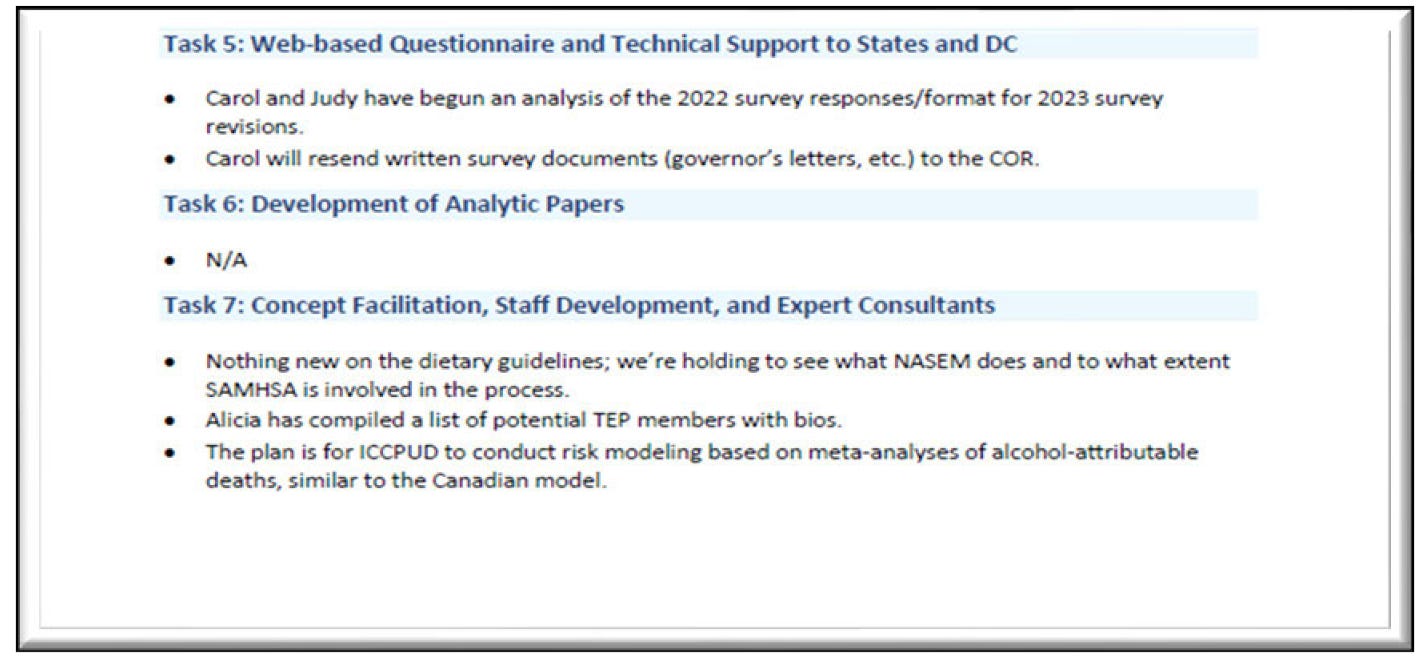
One could interpret this sentence alone as if its intent were to have an objective meta-analysis. That would be plausible if we did not know how the Canadian model had been constructed, or what it concluded. However, we do – and so did the ICCPUD and the Biden Administration. We reported on the Canadian model when its updated guidelines were first released and we were astounded by the lack of scientific rigor. The corresponding report released by the Canadian Centre for Substance Abuse (CCSA) details how the “Canadian model” was created. At first, the authors cherry-picked a mere sixteen out of 5934 studies on the effects of alcohol on a wide range of health outcomes considered. They systematically discarded studies that show a positive effect, yet did include two studies that correlate alcohol consumption to … accidents.
After hand-picking the studies, the authors then fed the studies’ results into a “risk model,” which was supposed to quantify the effect of a certain amount of alcohol consumption on life expectancy. In spite of their efforts to only select data conducive to a negative narrative around alcohol, the published Canadian model still did not provide conclusive evidence to have safe drinking guidelines adapted from maximally two beers a day to at most two beers a week, since the difference between both did not even amount to a half year of life expectancy. When reading the technical report from the Canadian Centre for Substance Abuse, one concludes that, while the authors did everything they could to make alcohol look bad, they still did not manage to come up with convincing results. Yet the CCSA Canada decided to change the safe drinking guidelines no matter what and back them up by a report that looked like it might contain thorough science, at least to those who do not bother to read the text.
Given that all this information was public by the time the Biden Administration instructed the ICCPUD to conduct “risk modeling similar to the Canadian model,” one can only conclude that they did not only sign off on a duplicative effort, which is illegal by itself, but they also instructed ICCPUD to create a study that was biased from the outset. The latter is illegal as well, since the Congressionally approved Appropriations Act states that any revision of the Dietary Guidelines “shall be based on the preponderance of scientific and medical knowledge.”
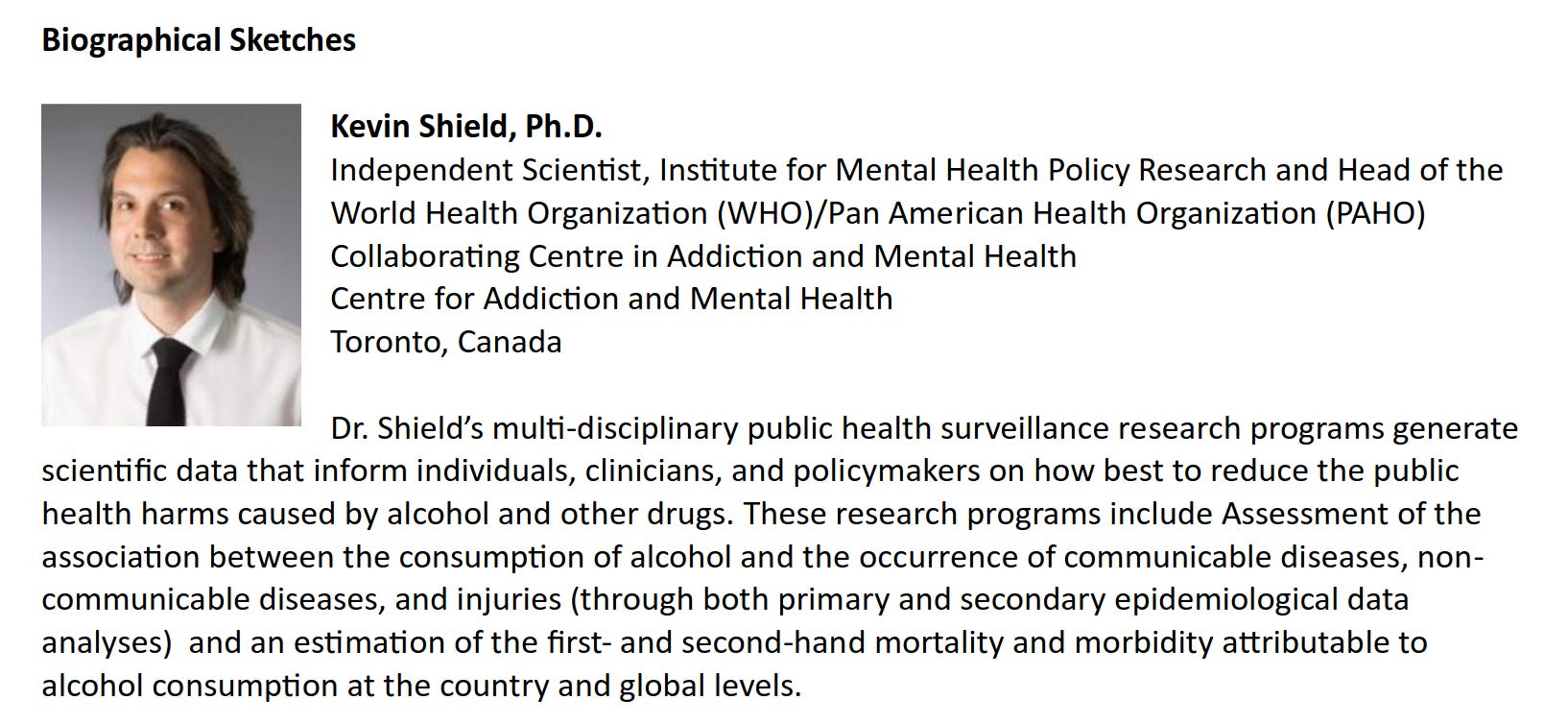
Undeterred by US Code, the Biden Administration and its ICCPUD soon assembled a group of scientists who were to author the forthcoming “rigorous” study — a study so rigorous that its outcome was known beforehand: it would echo the “Canadian model.” In so doing, the ICCPUD made sure not to have any dissenters on the committee. Alicia Sparks, a lifelong anti-alcohol policy lobbyist, was given the responsibility to identify members of the study group. Not surprisingly, she selected six “researchers,” all of whom have a long track record in publishing results that either try to link alcohol to mortality, or try to investigate how lawmaking can change drinking behaviours and reduce consumption. Moreover, the panel of six consisted of three US-based researchers … and three Canadian ones. The latter comprised Timothy Naimi and Kevin Shield, both of which ... contributed to the “Canadian model.” Should we be surprised that a committee of lifelong alcohol critics produces a report that concludes that “no level of alcohol consumption is safe?” Or that the resulting model is very similar to the “Canadian model,” given that the committee was instructed to produce exactly that, and contained members who had worked on the Canadian model in Canada as well?
Reading between the lines, Wild Horse Wisdom has long suspected government influence behind the scenes in the publication of recent, biased research results on public health that are presented as “thorough” and “objective.” This holds true on a panoply of topics: be it studies on epidemiology, vaccines, alternative treatments, or on the effects of common nutrients, such as “alcohol kills from the first drop” or “red meat causes cancer” – but apparently synthesized, fake meat substitutes are “healthy.” The difference this time, though, is that we have proof. Thanks to the Congressional Committee on Oversight and Government Reform, who subpoenaed HHS, we now know for a fact that the Biden Administration created a stacked-deck panel of experts who were given the explicit instruction to produce “research” of which the entirely bogus conclusions were known before it even started.
The five-year update to the dietary guidelines have meanwhile been published. The work by the Shield committee was disregarded. However, had the political wind not changed in Washington, DC, the US dietary guidelines would very likely have been aligned with the British and Canadian ones, based on the claim that “the science has changed.” That is exactly what happened at the World Health Organization, who since 2025 claim that “no amount of alcohol consumption is safe.” Remind us, who led the “research” that motivated the change in the WHO’s guidelines?
It wasn’t Kevin Shield too, was it? Turns out, it was. Maybe that explains why Kevin Shield’s co-authored paper so confidently states that it will “establish a scientific consensus.” One paper alone never establishes a “consensus,” but it may well appear to do so if it is put forward as the single source of truth by governments and by the WHO, who all the while collectively ignore evidence to the contrary. It seems indeed that one academic who staunchly opposes alcohol got carte blanche from institutions around the world to re-write their alcohol consumption guidelines, one at a time. It would be very interesting to learn what exactly happened behind the scenes in Canada too, or at the WHO. If it is possible to get that information through subpoenas or freedom of information requests, we will learn much more. The big lingering question, though, is WHY this is happening.
Why are governments around the world all of a sudden trying to demonize alcohol and trying to make their actions look “objective” and “scientific” by commissioning research that is biased from the outset? We can only guess, but here are a few observations. The push against alcohol arrives at the same time when other restrictions on bars are emerging, such as the UK’s “banter ban.” Bars are places where people meet and exchange ideas, as are churches. Britain has lost around two thousand five hundred pubs since 2019. Likewise, it witnesses over two hundred arson attacks on churches per year. Instead of there being a “war on cancer,” it seems that there very much is an ongoing war on social interaction. People can meet others randomly in such places in ways that are very hard to predict. Sometimes, they can even convince strangers of their own beliefs and opinions – all highly inconvenient, if one wanted to, say, ban meat in the name of an entirely concocted “climate emergency.”
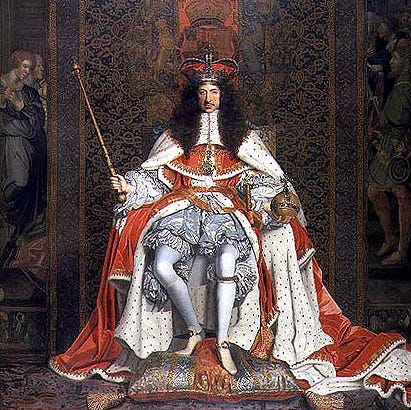
Those who think that King Charles III could in no way be in the business of banning pubs, better take heed at what happened in the year 1676, when King Charles II ordered coffee houses closed, as they “attracted idle and disaffected persons.” Of course, in reality it was common knowledge that criticism of the freshly restored monarchy was thriving in those same coffee houses. Fortunately, a ban on coffee houses seems highly unlikely today, doesn’t it? Or does it? At the World Economic Forum’s 2024 Annual Meeting, Swiss banking executive Hubert Keller was caught stating:
“The coffee that we all drink emits between 15 and 20 tonnes of CO₂ per tonne of coffee… Every time we drink coffee, we are basically putting CO₂ into the atmosphere.”
Hubert Keller, 2024 WEF Annual Meeting
“Debunkers” are all too keen to point out that this does not amount to the WEF having “declared a war on coffee.” It is correct that this statement alone does not amount to as much, indeed. Yet the fact that a statement that alleges coffee to be responsible for carbon emissions was made at a venue in which neo-Malthusian reduction of emissions was the main theme, is amenable to the conclusion that coffee may well be the next target. Let’s not be surprised when the WHO claims that “coffee kills from the first drop,” since “the science has changed” and the “link between coffee and cancer has been established with the same rigorous methods as were used for tobacco.” Or when the next update of the Dietary Guidelines advocates for a pre-emptive closure of breakfast restaurants.
As the National Academies’ study shows, the health hazards from moderate drinking are negligible at worst. There may even be health benefits. But let’s expand for a second beyond strict health outcomes. Beers and wines are enjoyable. They add to what makes life worth living, while acting as a social lubricant. When HHS published its updated dietary guidelines in 2025, Dr. Mehmet Oz, the administrator of the Centers for Medicare & Medicaid Services, told reporters that “the greater health risk is isolation, not alcohol.” A very wise comment indeed.

Bob likes to have his coffee out on the porch in the wee hours of the morning. But he also enjoys his beer next to the fire pit in the evening. We horses don’t care too much for the coffee, but if the government comes in to take our beer away … we may very well use of hind legs. They are a powerful deterrent.